
Home » General Geology » How Do Snowflakes Form?
How Do Snowflakes Form?
The life of a snowflake begins high in Earth's atmosphere, and if the snowflake is very lucky it might reach the ground.
Article by: Hobart M. King, PhD, RPG
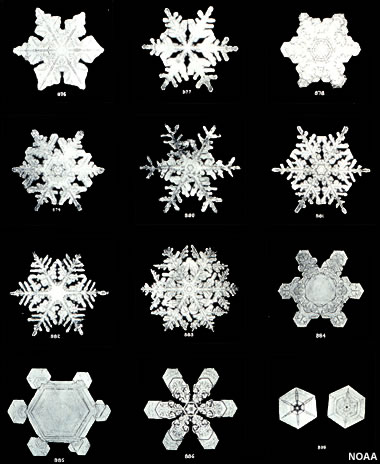
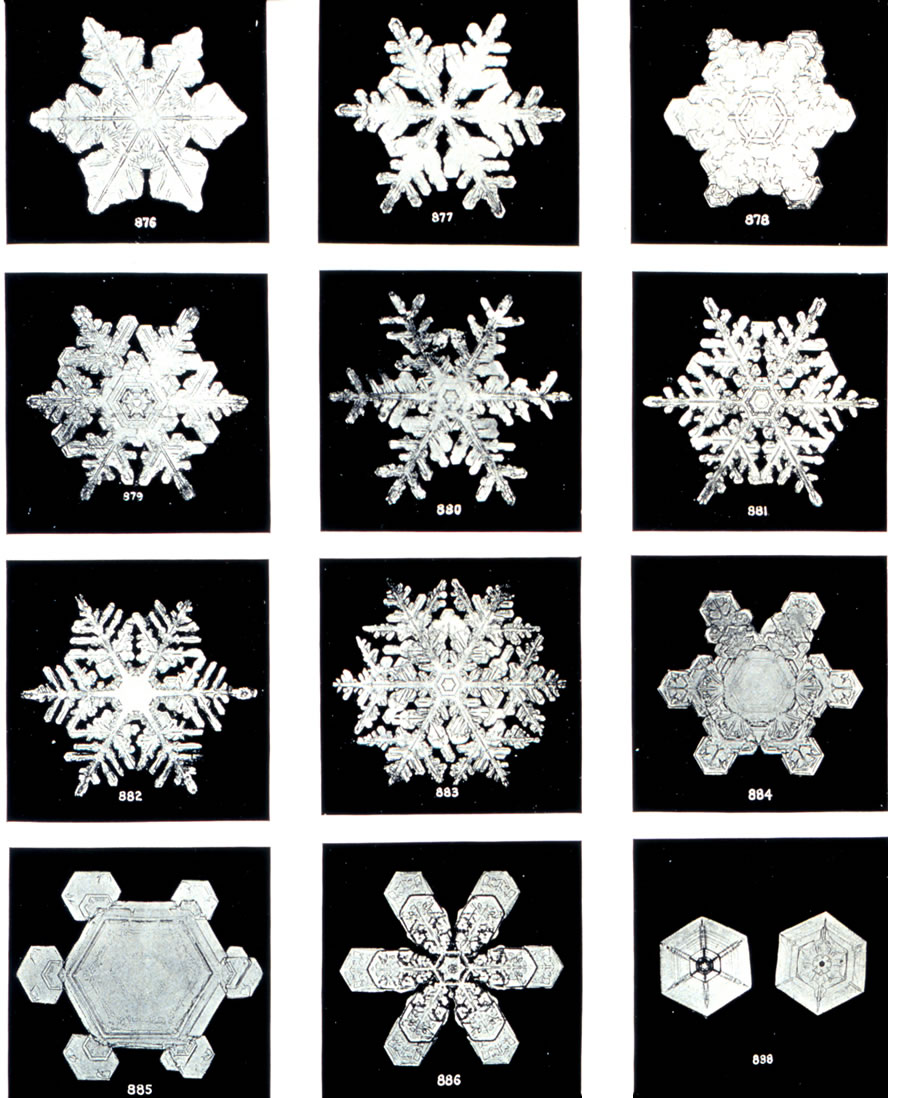
Snowflakes have unique shapes: Photographs of many snowflakes showing how each has a hexagonal crystalline structure but a unique geometry. The shapes of the flakes are determined by the atmospheric conditions experienced as it fell through the sky. Conditions of temperature and humidity can change as the flake falls and cause variations in crystal growth. Image by NOAA. Click to enlarge.
A Tiny Particle High in Earth's Atmosphere
A snowflake begins when a tiny dust or pollen particle comes into contact with water vapor high in Earth's atmosphere. The water vapor coats the tiny particle and freezes into a tiny crystal of ice. This tiny crystal will be the "seed" from which a snowflake will grow.
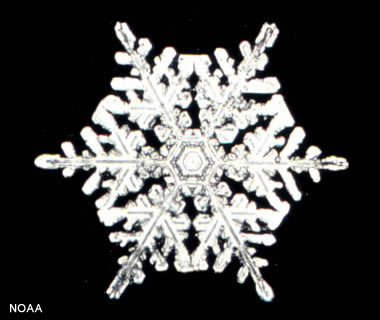
Snowflake crystal structure: Photograph of a snowflake revealing its hexagonal (six-sided) crystalline structure. This crystalline structure makes ice a "mineral." Image by NOAA.
Hexagonal "Mineral" Crystals
The molecules of water that form each tiny ice crystal naturally arrange themselves into a hexagonal (six-sided) structure. The result will be a snowflake with six sides or six arms. Ice crystals are "minerals" because they are naturally occurring solids with a definite chemical composition and an ordered internal structure.
The Snowflake Grows as it Falls
The newly-formed ice crystal (snowflake) is heavier than the surrounding air and it begins falling. As it falls towards Earth through humid air, more water vapor freezes onto the surface of the tiny crystal. This freezing process is very systematic. The water molecules of the vapor arrange themselves so that the hexagonal crystal structure of ice is repeated. The snowflake grows larger and larger as it falls, enlarging the hexagonal pattern.
Every Snowflake is Different!
Although all snowflakes have a hexagonal shape, other details of their geometry can vary. These variations are produced by different temperature and humidity conditions through which the snowflake falls. Some temperature/humidity combinations produce flakes with long needle-like arms. Other conditions produce flakes with wide flat arms. Other conditions produce thin, branching arms.
These different shapes have an unlimited number of variations, each representing the conditions of temperature and humidity and water vapor the snowflake encountered during its fall. A collection of snowflakes is shown at the top of this page. Notice the wide variety of shapes.
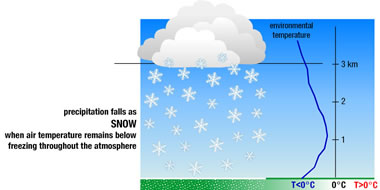
Atmospheric conditions for snow: Snowflakes form high in the atmosphere. They will reach the ground if the air temperature is below freezing all the way down. Image by NOAA.
Will They Reach the Ground as Snow?
The formation of snowflakes high in Earth's atmosphere does not guarantee snowfall on Earth's surface. That will only happen if air temperatures are below freezing all the way to the ground, as shown in the accompanying illustration.
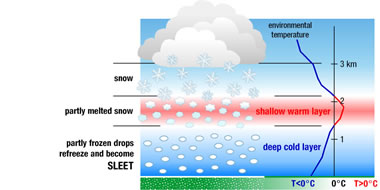
Atmospheric conditions for sleet: Snowflakes form high in the atmosphere. If they partially melt on the way down, then refreeze before landing, the result will be sleet. Image by NOAA.
Sleet!
If the snowflakes pass through a thin warm layer of air, they could experience partial melting. When they exit the warm air, they will refreeze on the way down in the form of a tiny ice pellet. This is how sleet forms.
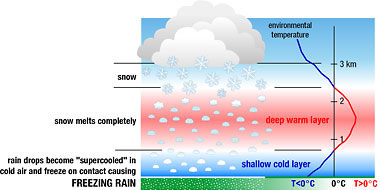
Atmospheric conditions for freezing rain: Snowflakes form high in the atmosphere. If they melt completely on the way down, then land on a cold Earth, the result will be freezing rain. Image by NOAA.
Freezing Rain
If the snowflakes pass through a layer of warm air that is thick enough to melt them completely, then land on a cold Earth surface, the result could be freezing rain.
The Complex Work of Meteorologists
Meteorologists have a challenging job. If they forecast snow, they need to determine when a moisture-laden air mass will pass over an area and if the temperature high at the snowflake-forming elevation will be below freezing. They also need to determine if the temperatures at lower elevations will allow the snowflake to fall to the ground. Finally, they need to know the conditions on the ground to determine if the snow will accumulate or melt.
If you think this is interesting and you like to be challenged, then you might make a great meteorologist. :-)
| More General Geology |
 |
Fossils |
 |
Igneous and Volcanic Features |
 |
Geology Dictionary |
 |
Diamonds |
 |
Minerals |
 |
Divisions of Geologic Time |
 |
Land Below Sea Level |
 |
Gifts That Rock |

Find Other Topics on Geology.com:
|
| ||
|

| ||
|
| ||
|
|