Rock Tumbler Comparisons and Reviews
We have sold thousands of rock tumblers. From that experience, we sell only those tumblers that have been successful with our customers. We don't sell cheap plastic-barrel tumblers that make a lot of noise or imported tumblers that quit working after a few batches of rock. The tumblers we sell will last through years of proper use. We also sell all of the supplies that you will need to enjoy the rock tumbling hobby. We have been in this business for years, and our ability to serve our customers is what makes us successful.
The members of our staff have been using rock tumblers for decades. We probably have tumblers running at our office while you are reading this. If you need information about rock tumbling, we have authored an extensive library of rock tumbling articles - with every article written from experience. If you need help with a tumbler purchased from us, you can find our contact information at the bottom of your packing slip and get in touch with us. Today, a lot of tumblers are sold by merchants who don't know anything about rock tumbling, or those who sell anonymously and are impossible to contact when you have a simple question.
You can read our customer reviews here, and some of them were probably written yesterday or this morning.
| Picture |
Tumbler Model / Description |
Barrels & Rock Capacity |
Price: |
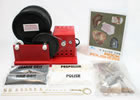
Thumler's MP-1: This is our best-selling rock tumbler. The soft rubber barrel is much quieter than the toy tumblers with a plastic barrel. It will last for years instead of weeks. This is the tumbler to buy if you want to try rock tumbling with minimal cost and minimal noise. Perfect for the beginner. This kit includes everything needed to start tumbling - plus a jewelry kit with keychain and necklace. Read a detailed review of the
MP-1 rock tumbler.
Age Recommendation: Children ages 14 and up with adult supervision.
Find out why.
Barrels: One
Capacity: About One Pound
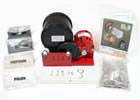
Thumler's A-R1: This kit gives you everything needed to start tumbling. You get a Thumler's A-R1 tumbler, grit, polish, rock, instruction book, and jewelry craft kit. A great gift for the beginner! The durable metal frame will last for years, and the soft rubber barrel will tumble your rocks quietly.
Age Recommendation: Children ages 14 and up with adult supervision.
Find out why.
Barrels: One
Capacity: About Two Pounds
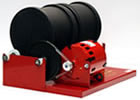
Thumler's A-R2: The Thumler's A-R2 tumbler has two three-pound barrels. It is very easy to use, and the soft rubber barrels will tumble your rock quietly. Having two barrels makes it easy for two people to share the same tumbler. Or, one person can experiment with different types of rock, or run rocks at different stages of the tumbling process. (We own two A-R2 tumblers and run one of them frequently.)
Age Recommendation: Children ages 14 and up with adult supervision.
Find out why.
Barrels: Two
Capacity: About Four Pounds
(two pounds in each barrel)
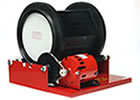
Thumler's A-R12: The Model A-R12 has a single 12 lb. rubber barrel. If you fill this barrel about 2/3 full of rock as recommended, it will process about eight pounds of rock. The soft rubber barrel will tumble your stones with a minimum amount of noise. Easily converts to a tumbler that can process two three-pound barrels like the A-R2. (3-pound barrels sold separately.)
Age Recommendation: This large-capacity tumbler should be used by adults.
Find out why.
Barrels: One
Capacity: About Eight Pounds
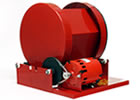
Thumler's Model B: The Model B has a single 15-pound-capacity metal barrel with a thick rubber liner, metal lid, and rubber lid gasket. If you fill this barrel about 2/3 full of rock as recommended, it will process about ten pounds of rock. The rubber liner and gasket will tumble your stones with a minimum amount of noise. It has a 1550rpm, thermally protected motor that is intended for tumbling rocks.
Age Recommendation: This is a large tumbler that should be used by adults.
Find out why.
Barrels: One
Capacity: About Ten Pounds
Vibratory Rock Tumbler Comparison
The table below compares features of every vibratory rock tumbler that we sell. Vibratory tumblers process rock in less than half the time required by a rotary tumbler. They also save you money by using a lot less grit and polish (less than 1/2 as much as a rotary tumbler of the same capacity).
Age Recommendation for Vibratory Tumblers: These are tumblers that require a bit of attention and are recommended for adults. Find out why.
We share information and videos on how we use the Lot-O-Tumbler in an article: How We Use the Lot-O-Tumbler, and how we use the Thumler's UV-10 in an article: Operating the Thumler's UV-10 Rock Tumbler.
| Picture |
Tumbler Model / Description |
Barrels & Rock Capacity |
Price: |
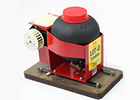
Lot-O-Tumbler Single: Polishes four pounds of rock in about a week and uses less than half of the grit required by a rotary tumbler. You will save lots of time and electricity too! Produces an amazing polish on agate, jasper, and many other materials. Quick and easy to clean. Just remove the lid to inspect your rock in the middle of a run. Requires dedication because this machine must be glued to a painted concrete block - but you will be smiling when you see your bright polish. :-)
Barrels: One
Capacity: About Four Pounds
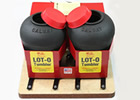
Lot-O-Tumbler Twin: Same as the Lot-O-Tumbler Single above - but with two barrels. The Lot-O-Tumbler Twin will process about eight pounds of rough rock. A very small price increase for the ability to polish twice as much rock.
Barrels: Two
Capacity: About Eight Pounds (four in each barrel)
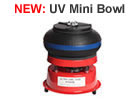
Thumler's UV Mini Bowl: A small-capacity vibratory tumbler that will process about four pounds of material. This tumbler has a heavy-duty polyethylene bowl designed to handle tumbling rocks.
Barrels: One
Capacity: About Four Pounds
We don't know when this tumbler will be available.More Information
Adult signature required upon delivery. |
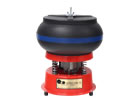
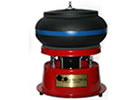
Thumler's U-V10: A great vibratory tumbler that will process about ten pounds of material. This is the "industrial model" designed to polish brass or a heavy load of rocks. It's a little more expensive than the standard model, but this is the machine needed for rock polishing.
Barrels: One
Capacity: About Ten Pounds
We don't know when this tumbler will be available.More Information
Adult signature required upon delivery. |
Thumler's U-V18: A durable vibratory tumbler that will process about eighteen pounds of material. This is the "industrial model" designed to polish a heavy load of rocks. It's more expensive than the standard model, but this is the machine needed for rock polishing.
Barrels: One
Capacity: About Eighteen Pounds
We don't know when this tumbler will be available.More Information
Adult signature required upon delivery. |
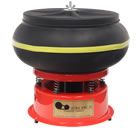
Thumler's U-V45: An extra-large vibratory tumbler that will process about forty-five pounds of material. Don't be fooled by the yellow band on the bowl - this is a heavy-duty machine that can polish 45 pounds of rocks (or up to 1000 brass ammunition cases). Suitable for a person with a good deal of physical strength and a LOT of rocks to tumble.
Barrels: One
Capacity: About Forty-five Pounds
We don't know when this tumbler will be available.More Information
Adult signature required upon delivery. |