You have to try this...
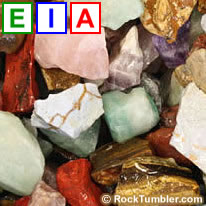
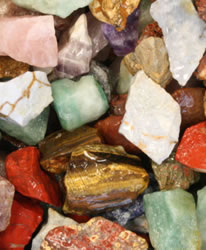
In our opinion, this is one of the great bargains on our website: you can get a colorful bag of mixed tumbling rough for a bulk price. In that bag you will find several materials that have been favorite tumbling roughs for the past fifty years - in pieces that range from 1/2" up to about 2 1/2". Some of the roughs that we typically see in these bags include: banded amethyst, gold tiger's eye, red jasper, picture jasper, green aventurine, rose quartz, sodalite, unakite, white quartz and more. Every bag is different, and every bag has lots of diverse color. More information, larger photo.
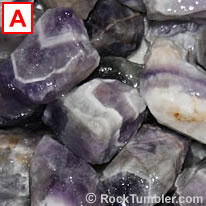
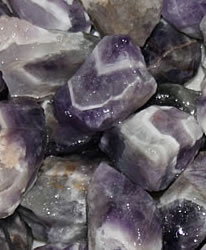
 We are selling two-pound bags of banded amethyst, specially sized for rock tumbling. Each bag contains mostly pieces that are between 1/2 to 2 inches in size. This material consists of beautiful purple amethyst, white milky quartz, and a small amount of gray smoky quartz. It is mined in Namibia, a country on the west coast of southern Africa. Banded Amethyst accepts a bright polish and makes beautiful tumbled stones. More information, photos, tumbling suggestions.
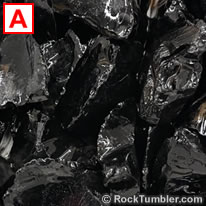
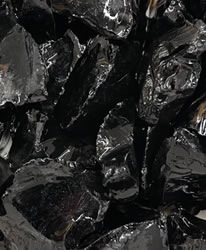
Obsidian is a volcanic glass, so you will need to use ceramic media when tumbling to help prevent chips and bruises to the stones. If you have a bit of experience and follow our instructions carefully, this material can be polished to a brilliant shiny luster. More information, photos, tumbling suggestions.
We are selling two-pound bags of banded amethyst, specially sized for rock tumbling. Each bag contains mostly pieces that are between 1/2 to 2 inches in size. This material consists of beautiful purple amethyst, white milky quartz, and a small amount of gray smoky quartz. It is mined in Namibia, a country on the west coast of southern Africa. Banded Amethyst accepts a bright polish and makes beautiful tumbled stones. More information, photos, tumbling suggestions.
Obsidian is a volcanic glass, so you will need to use ceramic media when tumbling to help prevent chips and bruises to the stones. If you have a bit of experience and follow our instructions carefully, this material can be polished to a brilliant shiny luster. More information, photos, tumbling suggestions.
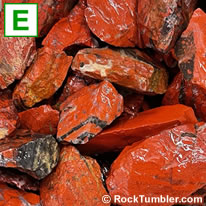
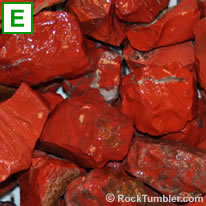
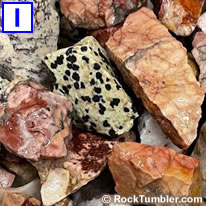
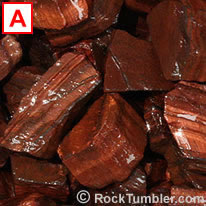
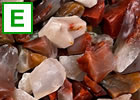
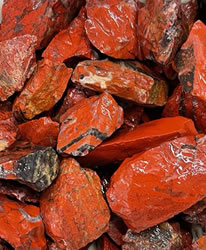
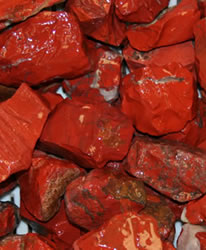
This is a bright red brecciated jasper. It is easy to polish, so this is a good material for the beginner to try. These pieces range from approximately 1/2" (12 mm) to 2" (51 mm) in size. Photographed wet to show full color. More information, photos.
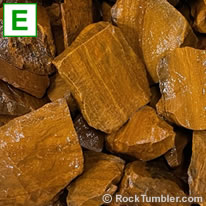
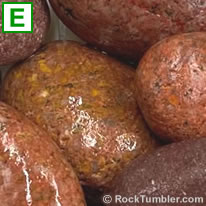
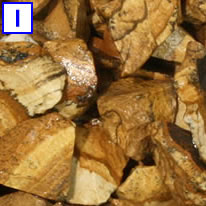
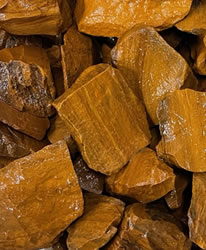
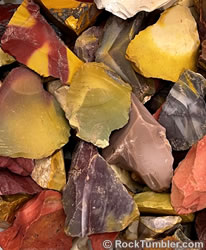
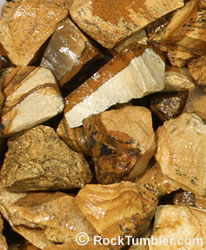
This is a slightly yellowish brown jasper. It rounds nicely, polishes easily, and we recommend it for beginners who are using a small rotary tumbler. These pieces range from approximately 1/2" (12 mm) to 2" (51 mm) in size. Photographed wet to show full color. More information, photos.
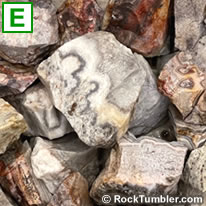
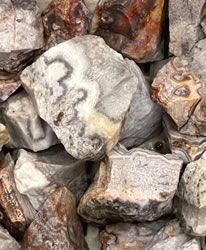
Crazy Lace Agate has been a favorite tumbling rough since the 1960s. The material we are selling is mostly gray and white agate with an intricate lace pattern. Photographed wet to show full color. More information, photos.
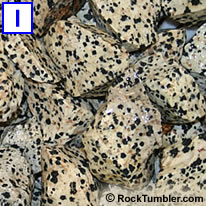
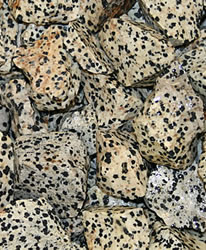
Dalmatian Stone is a white to beige-colored igneous rock with dark black spots. It is mined in Mexico and has been imported into the United States for many years. It gets its name from the famous breed of dogs with a similar appearance. It shapes nicely in a rock tumbler and accepts a soft glowing polish. Pieces are mostly 1/2 to 1 3/4 inches in size. Some people call this material "Dalmatian Jasper" but that name is a misnomer. More information, photos, tumbling suggestions.
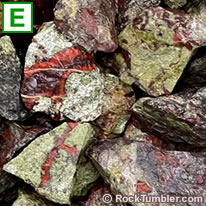
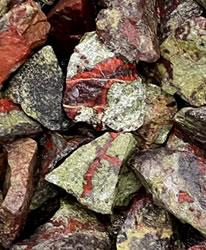
"Dragon Blood" is the name of a metamorphic rock that is partially composed of green epidote and red piemontite. With a Mohs hardness of 6+ to 7, it is a durable and tenacious material that can be used to make tumbled stones, cabochons, and other lapidary objects. It is easy for the beginner to tumble and takes a nice shiny polish. More information, photos, tumbling suggestions.
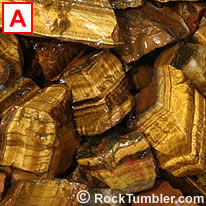
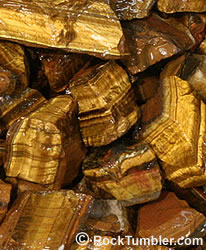
Tiger's Eye receives its name because of the way light interacts with the material. When moved in the light, the stone exhibits a line of light that moves across the surface of the stone. These tiger's eye roughs have become very popular with our customers. They are sized mostly between 1/2 and 2 inches. More information, photos, tumbling suggestions.
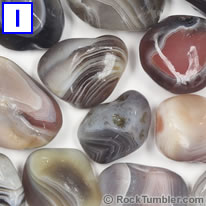
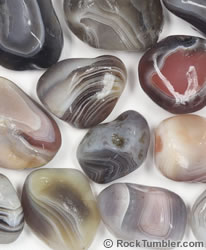
This tumbling rough consists of nodules and partial nodules of gray banded agate. The pieces range in size from about 1/2" to 1 1/2" in diameter. This agate has attractive banding in shades of gray, brown, cream, white, black, and reddish colors. If you are patient during the coarse grit step, making sure to grind away the weathering rind and any bruises, this material will produce wonderful tumbled stones with a brilliant polish! More information, photos, tumbling suggestions.
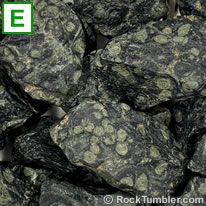
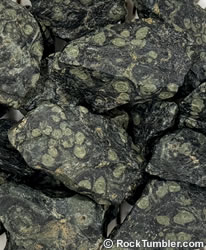
Kambaba is a green and black tumbling rough marked with circles and swirls that is mined in Madagascar. It produces tumbled stones with spectacular "eyes" and "orbs". Mostly in 1/2 to 2 inch pieces. Some people believe that it is a fossilized stromatolite (structures built by sediment-trapping algae), but experienced paleontologists do not accept that theory for its formation. Kambaba does not have the proper pattern of growth lines almost universally seen in stromatolite fossils. More information, photos, tumbling suggestions.
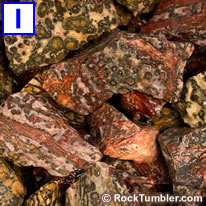
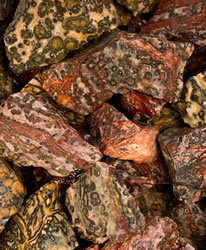
Leopard Skin is a marketing name for an igneous rock with markings that make it look like the coat of a leopard. It has lots of spots! Some people call it "leopard skin jasper" or "leopard jasper" but those names are incorrect. It is not a jasper. It shapes nicely in a rock tumbler and polishes to a soft glow - not a bright vitreous polish like you see in jasper. Leopard skin shapes quickly in a tumbler because it is a little softer than most other tumbling roughs (the minerals in the rock range between 5 and 7 on the Mohs hardness scale). We are selling this leopard skin in pieces that range between about 1/2 and 1 1/2 inches across. More information, photos, tumbling suggestions.
We think that this is the perfect magnesite for rock tumbling. It is very fine-grained and is slightly silicified. The silicification makes it harder than pure magnesite (which makes it easier to polish), and the fine grain size enables it to be tumbled without cleavage being a problem. With a Mohs hardness of 5+ this material shapes quickly, yet is hard enough to accept a soft glowing polish. More information, photos, tumbling suggestions.
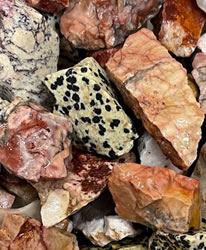
Mexico Mix is an assortment of igneous rocks, jasper, and agate. It is a great material for making beautiful tumbled stones in your rock tumbler. The rocks in the mix were mined in Mexico - and thus the name "Mexico Mix". If you order today and again in the future, you will likely receive a similar assortment of rock varieties. Often contains long-time tumbling favorites such as Dalmatian Stone and Crazy Lace Agate - plus a variety of igneous rocks, translucent chalcedonies, and interesting jaspers.
More information, photos, tumbling suggestions.
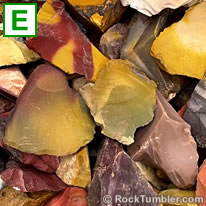
Mookaite is a colorful chalcedony that is named after Mooka Creek in Western Australia. This material has a Mohs hardness of about 7, is easy to tumble, and takes a bright polish. More information, photos, tumbling suggestions.
This is a brown, cream, and tan material from Namibia. It has wonderful patterns that are reminiscent of desert landscapes. Most of the pieces range between 1/2 to 2 inches (at their widest dimension), so this tumbling rough could also be used to create some very nice-looking cabochons. More information, photos, tumbling suggestions.
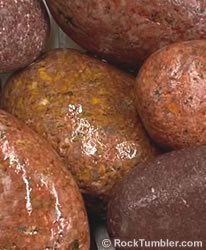
These big beach stones are much larger than the other tumbling roughs we sell, so you will need a large-capacity tumbler (such as a Thumler's Model B) to tumble them effectively. The rocks measure between 1 inch and 4 inches in maximum diameter. Although they have been rounded by nature, they have a thick weathering rind that must be removed with at least 2 weeks of tumbling in coarse grit. If you follow our instructions, you can produce big, shiny cobbles and pebbles! More information, photos, tumbling suggestions.
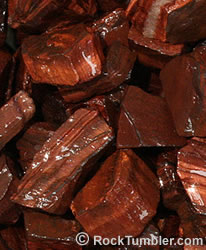
This red jasper from South Africa is one of our long-time favorite tumbling roughs. Why? Here are four reasons: 1) it accepts an awesome polish; 2) it has a spectacular red color; 3) it shapes nicely; and, 4) it is tough enough that bruising rarely occurs in the tumbler. That makes this rough easy and enjoyable to tumble. Mostly 1/2 to 2 inches in size. More information, photos, tumbling suggestions.
Tiger's Eye receives its name because of the way light interacts with the material. When moved in the light, the stone exhibits a line of light that moves across the surface of the stone. These tiger's eye roughs have become very popular with our customers. They are sized mostly between 1/2 and 2 inches. More information, photos, tumbling suggestions.
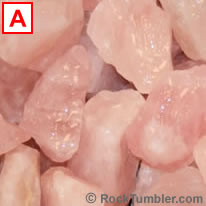
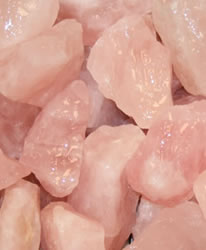
We are offering some beautiful rose quartz with a strong pink color. This material is from South Africa and is being sold in five-pound bags. It is a perfect size for making large tumbled stones. You might also slice these pieces into small slabs for cabbing or tumbling with a trim saw or small slab saw. Most of the material in these bags is in large chunky pieces that range in size between 1 to 2.5 inches along their maximum dimension. A few pieces might be a bit over or under those sizes. More information, photos, tumbling suggestions.
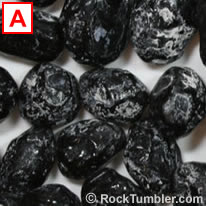
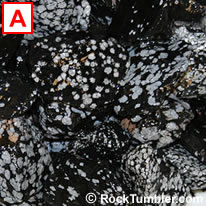
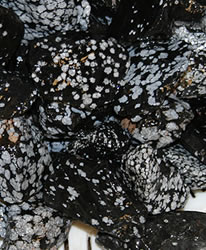
Snowflake Obsidian is a jet-black volcanic glass with small patches of white recrystallized material that give the appearance of "snowflakes". It produces beautiful tumbled stones if you cushion them during tumbling with ceramic cylinder media. It is softer than the normal agate or jasper that you might have tumbled before, so tumbling time will be slightly reduced - except for the polishing step. More information, photos, tumbling suggestions.
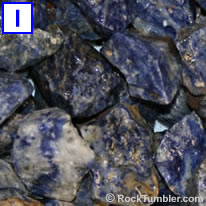
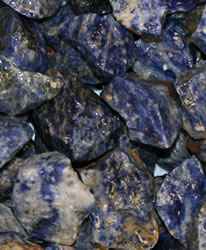
Sodalite is a rare blue mineral found mainly in igneous rocks. Some rocks containing abundant sodalite can be polished to a beautiful luster and are durable enough for a variety of uses. When polished they often display attractive white patterns produced by other minerals dispersed through the rock. Mostly in 1/2 to 2 inch pieces. More information, photos, tumbling suggestions.
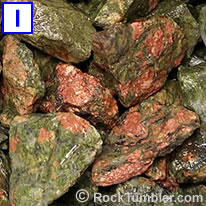
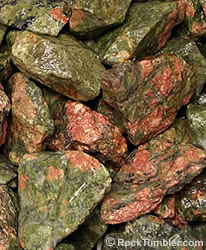
Unakite is an igneous rock composed of green epidote and pink orthoclase. It was named after the Unaka mountains in North Carolina and Tennessee (although it is found in other parts of the world as well). More information, photos, tumbling suggestions.
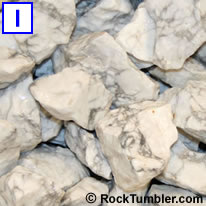
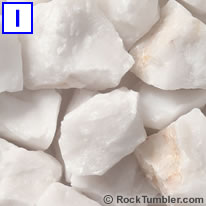
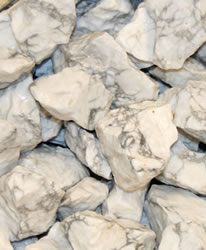
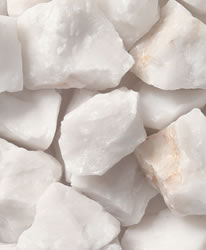
This is a good material to try if you do not have any experience with tumbling quartz. Since it is snow-white, its color will camouflage any small bruises and scratches that may occur in a rotary tumbler. More information, photos, tumbling suggestions.


 EASY
EASY  INTERMEDIATE
  ADVANCED