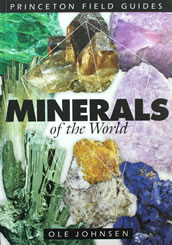
Princeton Field Guides presents
Minerals of the World
by Ole Johnsen
Minerals of the World - Princeton Field Guides
|
|
| PART I: MINERALOGY AND CRYSTALLOGRAPHY | |
| What is a Mineral? |
11
|
| Mineral names |
15
|
| Crystallography |
18
|
| Crystal geometry |
19
|
| The cubic system |
26
|
| The tetragonal system |
31
|
| The hexagonal system |
34
|
| The trigonal system |
37
|
| The orthorhombic system |
41
|
| The monoclinic system |
43
|
| The triclinic system |
45
|
| Formation and growth of crystals |
46
|
| The chemical properties of crystals |
54
|
| The physical properties of crystals |
60
|
| The optical properties of crystals |
65
|
| PART II: MINERAL DESCRIPTIONS | |
| Native elements |
77
|
| Sulphides |
93
|
| Halides |
129
|
| Oxides and hydroxides |
145
|
| Carbonates, nitrates, and borates |
183
|
| Sulphates, chromates, molybdates, and tungstates |
209
|
| Phosphates, arsenates, and vanadates |
227
|
| Silicates |
249
|
| Nesosilicates |
253
|
| Sorosilicates |
275
|
| Cyclosilicates |
287
|
| Inosilicates |
299
|
| Phyllosilicates |
331
|
| Tectosilicates |
354
|
| Organic minerals |
395
|
| PART III: TABLES | |
| Common minerals and their properties |
397
|
| Table 1. Minerals with metallic or submetallic lustre |
398
|
| Table 2. Minerals with non-metallic lustre |
402
|
| The Periodic Table of the Elements |
421
|
| Symbols and atomic numbers of selected elements |
422
|
| Glossary |
423
|
| Index |
429
|
ADVERTISEMENT