Gary Smith, a gold panner from British Columbia with 40 years of experience, demonstrates his panning methods and gives advice.
Learn How to Pan for Gold
The best way to learn about panning for gold is to observe the techniques of successful panners. Although the methods of these four panners are not identical, they share two common goals:
get the heavy gold particles to settle to the bottom of the pan by vigorously shaking the sediment-water mixture
reduce the amount of sediment in the pan by gently washing off the top layer of material
ADVERTISEMENT
Observe how each of the four panners achieves these two goals. Keep them in mind while you are prospecting for gold.
Some people practice panning by placing small pieces of metal such as snips of copper wire in a small amount of sediment and pan them out. Gold (19.30 grams/cubic centimeter) has a much higher density than copper (8.94 grams/cubic centimeter), so if you can successfully pan the copper you will have little trouble panning gold.
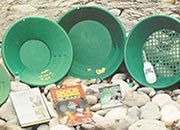
Looking for gold? We have over 50 different gold books and gold maps that show where gold has been found in the past and provide instruction on gold prospecting methods. Also available are gold pans in a variety of sizes and gold panning kits which include everything that you will need.
Even though their language is different, their methods are the same. This prospector is prepared for the cold water with hip boots and heavy gloves.
Mike Davis demonstrates his panning method emphasizing the importance of getting gold to settle to the bottom of the pan and gently washing the top layer of sand out of the pan. He also shows how to use a "snuffer" bottle.