Plate Tectonics: Theory, Diagrams & Boundaries
Definition:
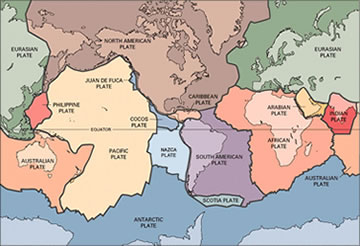
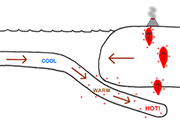
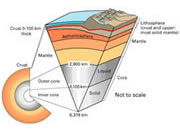
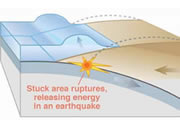
A theory that the Earth outer shell consists of a series of rigid plates known as the lithosphere. These plates move in response to convection currents within the mantle. The interactions of the plates at their boundaries yield earthquakes, volcanic activity, ocean trenches, island chains, mountain ranges and other features.
Plate Tectonics Resources:
Listed below are websites and pages where you can learn more about plate tectonics.
Explore plate tectonics through satellite photos and maps on an interactive website. Zoom in on the volcanoes, islands, faults, lakes, mountains and more that reveal divergent, convergent and transform plate boundaries.
This website delves into plate tectonics, sea-floor spreading, subduction zones, as well as hot spots. This website offers a complete description of each topic and how they all interact with each other. Every aspect of each topic is discussed fully and is very easy to follow. This website not only hits these topics on the surface of the discussion, it gives real examples of these events that are happening in day-to-day life.
Have you ever questioned the theory of plate tectonics? This website will clear
up your questions with a detailed explanation of supporting evidence that has been
gathered from the continents. This information is useful for proving this theory.
This website also explains how investigations into plate tectonics are still
conducted today along with the importance plate tectonics have created to mankind.
There is an interactive map, a glossary, a few games, and even a quiz with this
website so you can test your knowledge and improve what you do not know.
W. Jacquelyne Kious and Robert I. Tilling are the authors of this website on plate
tectonics. This website offers a complete explanation for plate tectonics. It has
a wide range of material including: diagrams on the historical perspective of the
Earth’s surface which has been changing with each time period, it explains Wegener's
theory of plate tectonics and lists the four major scientific developments that helped
propel this theory,------ (1) demonstration of the ruggedness and youth of the ocean
floor; (2) confirmation of repeated reversals of the Earth magnetic field in the
geologic past; (3) emergence of the seafloor-spreading hypothesis and associated
recycling of oceanic crust; and (4) precise documentation that the world's earthquake
and volcanic activity is concentrated along oceanic trenches and submarine mountain
ranges------, illustrations of the four types of plate boundaries and explanations
for each boundary, a good explanation for what drives the plates with helpful diagrams
is used, and the effects that this has on people are included in this website.
This website offers a complete explanation of Alfred Wegener’s proposition of plate
tectonics. There is a also a timeline that allows you to click on the subdivisions
and learn more about the stratigraphy, ancient life, and localities for that time
period. One great feature to this website is the animations it has. The animations
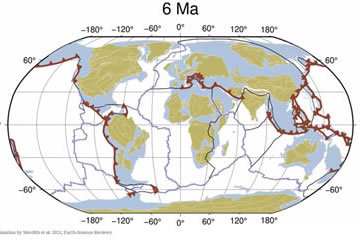
include the break up of Pangaea, subduction zones, construction of Pangaea for each
time period, etc. This website has a globe that allows you to view continental positions
for certain time periods. A good overview of the mechanisms to plate tectonics is also
explained in detail on this website. Ranging from the crustal plates, to the ocean floors,
to the convection currents, this website offers a great deal of explanation.
This website offers a great deal of information by using animations and illustrations.
Christopher R Scotese has created a website to show the Earth's history with animations
and illustrations that allow a visualization of the movement of the plates. There is a
wonderful timeline that is clickable and gives the climate for that time period. This
website allows a virtual tour back 1100 million years.
This website explains the formation of Pangaea from the first collisions to the
final stages and leftover pieces. There is an explanation into plate tectonics
that is for the beginning level. This explanation leads up to a greater
understanding for the 4 different lessons they have: Buoyancy and Floating Continents,
Sedimentation and Continental Growth, Continental collisions, and the Mechanisms of
Plate Tectonics. This website gives general information so that the theory of plate
tectonics can be understood better.
This site by the United States Geological Survey explains the connection between
earthquakes and plate tectonics. Provide are maps of the world with plate boundaries
along with explanations of four types of seismic zones: 1) shallow earthquake zones
associated with mid-ocean ridge divergent boundaries;
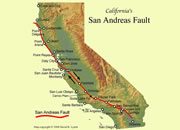
2) shallow focus transform boundaries such as the San Andreas fault zone;
3) subduction zones of deep earthquake activity such as convergent boundaries
between oceanic and continental lithosphere;
and, 4) intense zones of earthquake activity in mountain building zones such as the Himalayas and
Alps.
This site targets K-12 education and suggestions for teachers. Topics are presented with numerous simple diagrams. Topics include: earth's internal structure, evidences used to support the continental drift concept (jigsaw puzzle continent fit, fossils, rock sequences, glaciation. Also information on apparent polar wandering, problems with the continental drift theory, seafloor spreading, seafloor magnetics, subduction, birth of the plate tectonics concept, lithospheric plates, types of plate motion and types of plate boundaries.
|