
Uses of Lead
Lead has been used by humans for a variety of purposes for more than 5,000 years.
Republished from a 2011 Fact Sheet by S.J. Kropschot and Jeff L. Doebrich of the United States Geological Survey.
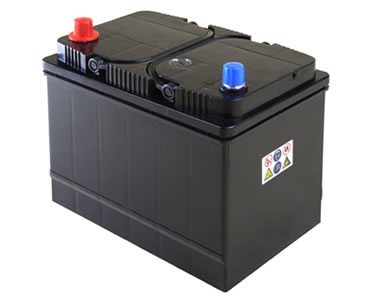
Lead-acid car battery: Typical lead-acid ignition batteries in automobiles contain about 10 kilograms of lead and need to be replaced every 4 to 5 years. Lead-acid batteries also supply standby power for computer networks and telecommunications systems, and energy storage for wind and solar energy systems and hybrid-electric vehicles. Image copyright iStockphoto / Hywit Dimyadi.
The Changing Uses of LeadScientific research demonstrating how accumulated ingested lead is toxic to human health and how accumulations of lead in the soil, air, and water are toxic to ecosystems is changing both how lead is used and how it is disposed of after use. |
| Did you know? In 2009, with a 96 percent recycling rate, the standard lead-acid car battery was the most recycled product in the United States. |
Ancient Uses of Lead
Water pipes that date back to the Roman Empire, glazes on prehistoric ceramics, and the cosmetic kohl, used by ancient Egyptians to darken their eyelids, are a few examples of ancient uses of lead. Today, lead, which has been mined on all continents except Antarctica, is one of the most important metals to industrialized economies.
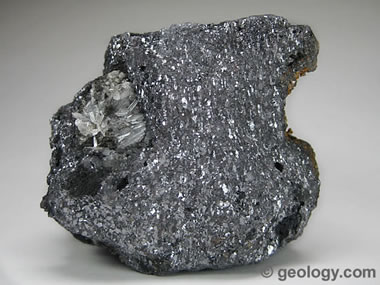
Galena, a lead sulfide mineral (PbS), is the primary ore of lead. It is mined at many locations worldwide.
Modern Uses of Lead
Prior to the early 1900s, lead was used in the United States primarily in ammunition, burial vault liners, ceramic glazes, leaded glass and crystal, paints or other protective coatings, pewter, and water lines and pipes. Following World War I, the demand for lead increased because of growth in the production of motorized vehicles, many of which use lead-acid batteries to start their engines. The use of lead as radiation shielding in medical analysis and video display equipment and as an additive in gasoline also contributed to an increase in the demand for lead.
By the mid-1980s, a significant shift in the uses of lead had taken place in the United States as a result of compliance with environmental regulations and the substitution of other materials for lead in nonbattery products, such as gasoline, paints, solders, and water systems. By the early 2000s, 88 percent of apparent U.S. lead consumption was in lead-acid batteries, which was a substantial increase from 1960 when only 30 percent of global lead consumption was in lead-acid batteries. Today, the other significant uses of lead are in ammunition, oxides in glass and ceramics, casting metals, and sheet lead.
| Did you know? Lead levels in ambient air are currently 92 percent lower than they were in 1980, owing to changes resulting from the Clean Air Act of 1970. |
Lead in the Environment
According to the U.S. Agency for Toxic Substances and Disease Registry, environmental levels of lead have increased more than 1,000-fold over the past three centuries as a result of human activity. The greatest increase took place between 1950 and 2000 and reflected the increased use of leaded gasoline worldwide. During this period, the U.S. Government established Federal regulations and made recommendations to limit lead emissions to protect public health in the United States.
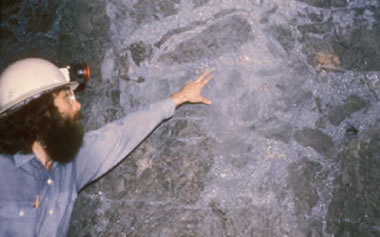
Lead mine: The Viburnum Trend in southeastern Missouri contains the largest concentration of lead in North America. The Buick mine is one of six underground mines that currently produce lead in the Viburnum Trend ore district. Image by USGS.
Types of Lead Deposits
Research to better understand the geologic processes that form mineral deposits, including those containing lead, is an important component of the USGS Mineral Resources Program. Lead commonly occurs in mineral deposits along with other base metals, such as copper and zinc. Lead deposits are broadly classified on the basis of how they are formed. Lead is produced mainly from three types of deposits: sedimentary exhalative (Sedex), Mississippi Valley type (MVT), and volcanogenic massive sulfide (VMS).
Sedimentary Exhalative Deposits
Sedex deposits account for more than 50 percent of the world's lead resources. They are formed when metal-rich hot liquids are released into a water-filled basin (usually an ocean) or in basin sediments, which results in the precipitation of ore-bearing material within basin-floor sediments.
Mississippi Valley Deposits
MVT deposits are found throughout the world and get their name from deposits that occur in the Mississippi Valley region of the United States. The deposits are characterized by ore mineral replacement of the carbonate host rock; they are often confined to a single stratigraphic layer and extend over hundreds of square kilometers. MVT deposits were a major source of lead in the United States from the 19th century through the mid-20th century.
Volcanogenic Massive Sulfide Deposits
In contrast to Sedex and MVT deposits, VMS deposits have a clear association with submarine volcanic processes. They also can contain significant amounts of copper, gold, and silver, in addition to lead and zinc. The "black smoker" sea vents discovered during deep ocean expeditions are examples of VMS deposits being formed on the sea floor today.
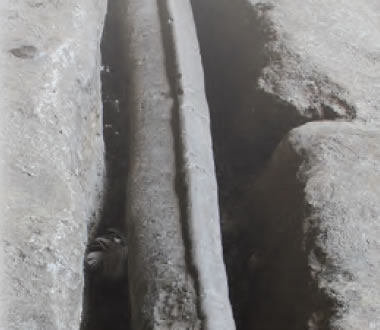
Lead pipes, such as these discovered in Bath, England, were used for plumbing by ancient Romans. Image by USGS.
| Did you know? The English words plumbing, plumber, plumb, and plumb-bob derive from the Latin word for lead. |
Worldwide Supply of and Demand for Lead
Currently, approximately 240 mines in more than 40 countries produce lead. World mine production was estimated to be 4.1 million metric tons in 2010, and the leading producers were China, Australia, the United States, and Peru, in descending order of output. In recent years, lead was mined domestically in Alaska, Idaho, Missouri, Montana, and Washington. In addition, secondary (recycled) lead is a significant portion of the global lead supply.
World consumption of refined lead was 9.35 million metric tons in 2010. The leading refined lead consuming countries were China, the United States, and Germany. Demand for lead worldwide is expected to grow largely because of increased consumption in China, which is being driven by growth in the automobile and electric bicycle markets.
Lead Production and Reserves | ||
| Country | Production | Reserves |
| USA | 400 | 7,000 |
| Australia | 620 | 27,000 |
| Bolivia | 90 | 1,600 |
| Canada | 65 | 650 |
| China | 1,600 | 13,000 |
| India | 95 | 2,600 |
| Ireland | 45 | 600 |
| Mexico | 185 | 5,600 |
| Peru | 280 | 6,000 |
| Poland | 35 | 1,500 |
| Russia | 90 | 9,200 |
| South Africa | 50 | 300 |
| Sweden | 65 | 1,100 |
| Other | 330 | 4,000 |
| Total | 4,100 | 80,000 |
| Data is in thousand metric tons. Data from USGS Mineral Commodity Summary, January 2011. | ||
Ensuring Future Supplies of Lead
To help predict where future lead supplies might be located, USGS scientists study how and where identified lead resources are concentrated in the Earth's crust and use that knowledge to assess the likelihood that undiscovered lead resources exist. Techniques to assess mineral resource potentials have been developed and refined by the USGS to support the stewardship of Federal lands and to better evaluate mineral resource availability in a global context.
| Lead Information |
|
Production and consumption of lead: Lead Statistics and Information from USGS.
Assessment of Undiscovered Deposits of Gold, Silver, Copper, Lead, and Zinc in the United States: By the U.S. Geological Survey National Mineral Resource Assessment Team. U.S. Geological Survey Open-File Report 02-198, 2002. A Deposit Model for Mississippi Valley-Type Lead-Zinc Ores: David L. Leach, Ryan D. Taylor, David L. Fey, Sharon F. Diehl, and Richard W. Saltus. U.S. Geological Survey Scientific Investigations Report 2010–5070-A, 2010. Geologic Criteria for the Assessment of Sedimentary Exhalative (Sedex) Zn-Pb-Ag Deposits: Poul Emsbo, U.S. Geological Survey Open-File Report 2009−1209, 2009. A New Occurrence Model for National Assessment of Undiscovered Volcanogenic Massive Sulfide Deposits: W.C. Pat Shanks III, Cynthia Dusel-Bacon, Randolph Koski, Lisa A. Morgan, Dan Mosier, Nadine M. Piatak, Ian Ridley, Robert R. Seal II, Klaus J. Schulz, John F. Slack, and Roland Thurston. U.S. Geological Survey Open-File Report 2009–1235, 2009. |
United States Lead Resources
In the 1990s, the USGS conducted an assessment of U.S. lead resources and concluded that about as much lead remained to be found as had already been discovered. Specifically, the USGS found that 92 million metric tons of lead had been discovered and estimated that about 85 million metric tons of lead remained undiscovered in the United States.
Mineral resource assessments are dynamic. Because they provide a snapshot that reflects our best understanding of how and where resources are located, the assessments must be updated from time to time as better data become available and new concepts are developed. Current research by the USGS involves updating mineral deposit models and mineral environmental models for lead and other important nonfuel commodities and improving the techniques used to assess for concealed mineral resource potential. The results of this research will provide new information and decrease the amount of uncertainty in future mineral resource assessments.




Find Other Topics on Geology.com:
|
| ||

|
| ||

|
| ||

|
|