
Home » Rocks » What is Rock Art? » Petroglyph Photos
Petroglyph Photo Gallery
A petroglyph is an image that is carved into a rock. This "carving" can produce a visible indentation in the rock or it can simply be the scratching away of a weathered surface to reveal unweathered material of a different color below. It is not a "drawing" or a "painting" - those are "pictographs."
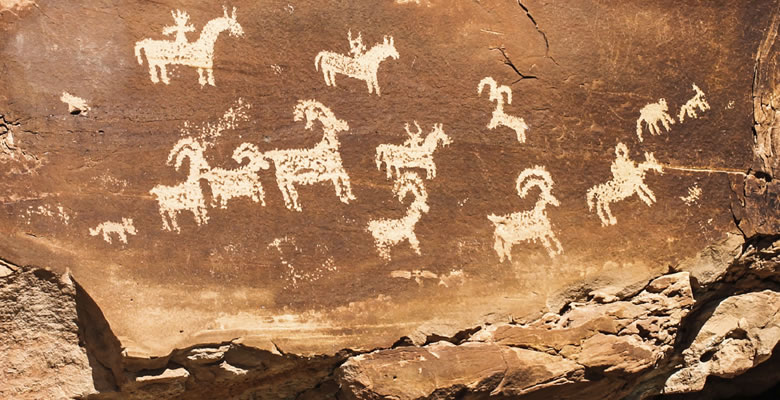
Petroglyphs: Ute petroglyphs from Arches National Park, Utah, USA. Image copyright iStockphoto / Giuseppe Aielli.
| Petroglyphs: Newspaper Rock, Utah |
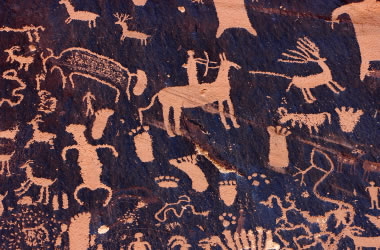
Petroglyphs photographed at Newspaper Rock State Park near Monticello, Utah, USA. These were produced by scraping away a thin desert varnish to reveal the bright sandstone below. Most of the images here are thought to have been created by Native Americans in prehistoric and historic time. The images were created over a wide range of time because the younger ones display a bright sandstone with almost no desert varnish, while the older ones have a distinct repatination. This single rock has one of the largest known collections of petroglyphs and hence has been given the name "Newspaper Rock." Image copyright iStockphoto / Geir-Olav Lyngfjell.
| Petroglyphs: Montezuma Castle, Arizona |
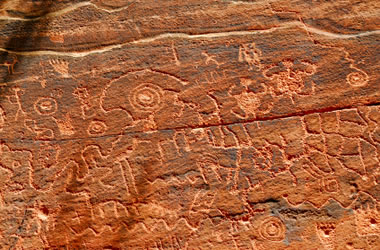
These are Native American petroglyphs carved into sandstone at Montezuma Castle National Monument in Arizona, USA. Image copyright iStockphoto / Richard Paul.
| Petroglyphs: Bishop, California |
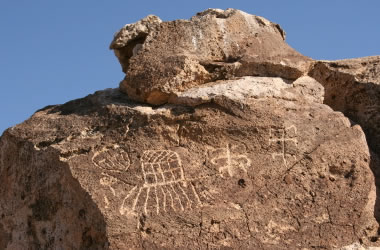
Native American petroglyph photographed near Bishop, California. Image copyright iStockphoto / Philip Robertson.
| Petroglyphs: Provincial Park, Ontario |
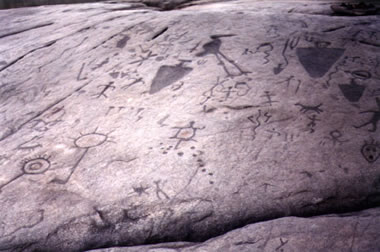
Petroglyphs on a rock surface in Provincial Park, Ontario, Canada. Image copyright iStockphoto / Daniel Norman.
| Petroglyphs: Kola Peninsula, Russia |
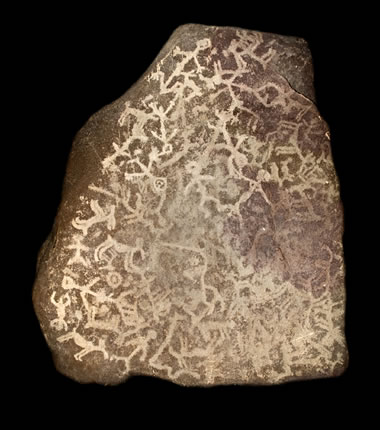
Petroglyphs on an ancient boulder found on the Kola Peninsula of Russia. Image copyright iStockphoto / Andrey Stenkin.
| Petroglyphs: Teruel, Spain |
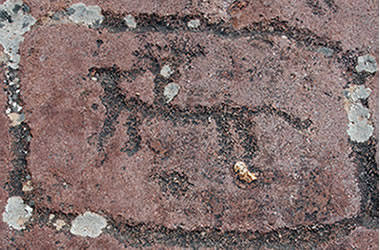
Petroglyph of a warrior on horseback photographed near Teruel, Spain. It is believed to have been created between the 4th and 2nd century BC. Image copyright iStockphoto / asterix0597.
| Petroglyphs: Norte Chico, Chile |
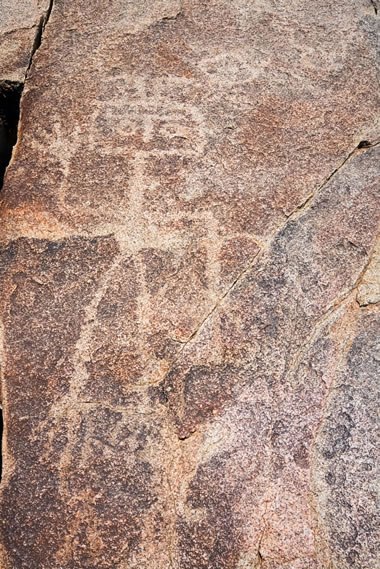
This is a photo of a petroglyph from the Valle de Encanto archeological monument in the Norte Chico region of Chile. Image copyright iStockphoto / Steve Geer.
| Petroglyphs: Tanumshede, Sweden |
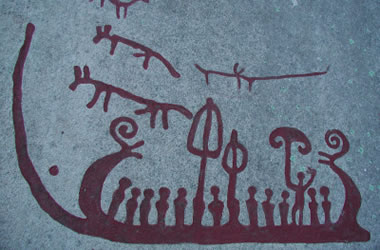
This is a Nordic Bronze Age petroglyph that is carved into the Vitlyckehäll stone near Tanumshede, in Västra Götaland County, western Sweden. The Vitlyckehäll stone is the largest surface that contains these carvings, which were discovered in 1972 by a construction project crew. This area has about 3000 petroglyphs and has been designated as a United Nations World Heritage site. As with the Alta, Norway petroglyphs shown on this page, the red ochre paint has been added to restore what is believed to be the original appearance. Image copyright iStockphoto / Matt Trommer.
| Petroglyphs: Hawaii |
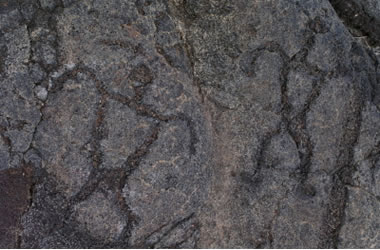
This is a photo of some unattributed petroglyphs of human-like figures carved into basalt on the island of Hawaii, USA. Image copyright iStockphoto / Craig Smith.
| Petroglyphs: Alta, Norway |
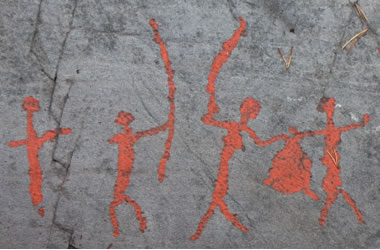
These petroglyphs were photographed at a World Heritage site near the town of Alta in northern Norway. They are carved into the rock and filled with red ochre paint. The earliest petroglyphs at this site date back to about 4200 BC and the more recent to about 500 BC. At the time these petroglyphs were produced, northern Norway was occupied by a culture of hunter-gatherers.
The first petroglyph at this site was not discovered until 1972 because they were overgrown by moss and lichens. Since then over 5000 petroglyphs have been discovered in this area, and the plants obscuring them have been carefully removed. Researchers believe that the carvings were made with quartzite chisels and a red ochre paint added to enhance their appearance. Recent restoration work has added the red paint onto only those carvings that are used for public display. The images trace the introduction of tools into the local culture and depict daily activities. Image copyright iStockphoto / Tessa van Riemsdijk.
| Petroglyphs: Bella Coola, British Columbia |
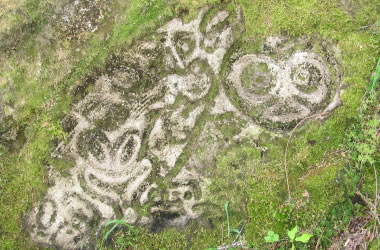
These petroglyphs were photographed near Bella Coola, British Columbia, Canada. They are believed to have been made by the Native American Nuxalk people. Many of them are thought to have been made between 5,000 and 10,000 years ago. Most petroglyphs are carved on vertical surfaces; however, many of the Bella Coola petroglyphs were carved on flat rock outcrops. Image copyright iStockphoto / Wolfgang Zintl.
| Petroglyphs: Arches National Park, Utah |
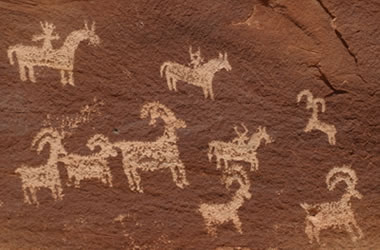
Ute petroglyphs photographed near Wolf Ranch, Arches National Park in Utah, USA. They are thought to have been created between 1650 and 1850. Image copyright iStockphoto / Michael Thompson.
| Petroglyphs: Nine Mile Canyon, Utah |
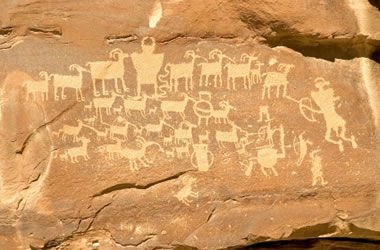
These petroglyphs are thought to have been carved by the Fremont people in what is now Nine Mile Canyon, near Price, Utah, USA. Featured are hunters with bows and arrows, and bighorn sheep. Image copyright iStockphoto / David Crowther.
| Petroglyphs: Capitol Reef, Utah |
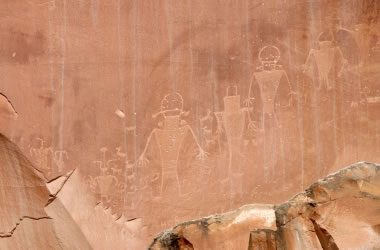
This wall of petroglyphs is located in Capitol Reef National Park, Utah, USA. They are thought to have been created by people of the Fremont Culture who lived in this area between 700 and 1300 AD. Image copyright iStockphoto / Scott Nelson.
| Petroglyphs: Ladakh, India |
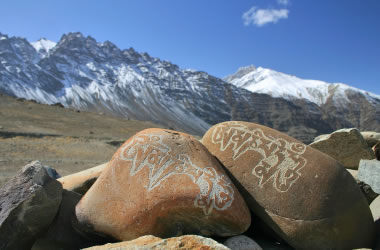
Rocks with a Buddhist prayer inscription. Ladakh, India, Himalayas. There are many rock carvings throughout this area, some of which have been dated to Neolithic times. Image copyright iStockphoto / Vladimir Melnik.
| Petroglyphs: Copper Canyon, Mexico |
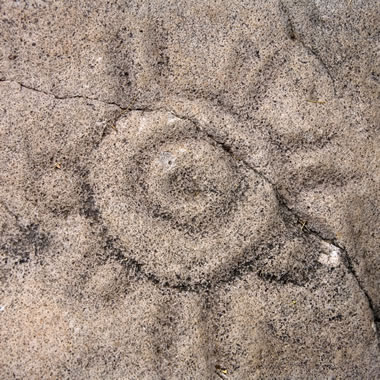
Petroglyphs of the Copper Canyon, Mexico area. Image copyright iStockphoto / Alan Tobey.
| Petroglyphs: New Mexico |
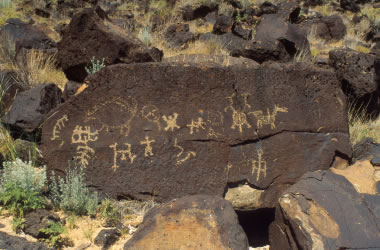
Petroglyph National Monument is a location where there are an estimated 25,000 petroglyphs, mostly scattered across the landscape on large boulders. Experts estimate that about 90% of them were created by ancestors of today's Pueblo people between about 1300 and 1680 AD. Image copyright iStockphoto / Jerry McElroy.
| Petroglyphs: Twyfelfontein, Namibia |
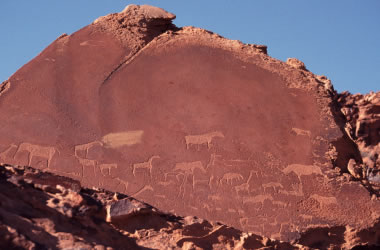
Petroglyphs of animals at a site near Twyfelfontein, Namibia. They are thought to have been made by local tribespeople, and no date of their creation is available. Image copyright iStockphoto / Liz Leyden.
| Petroglyphs: Vantage, Washington |
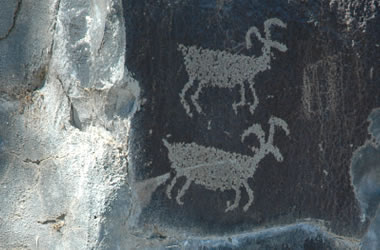
Petroglyphs of sheep photographed at Gingko State Park, near Vantage, Washington. Image copyright iStockphoto / 63alfred.
| Petroglyphs: Wadi Rum Desert, Jordan |
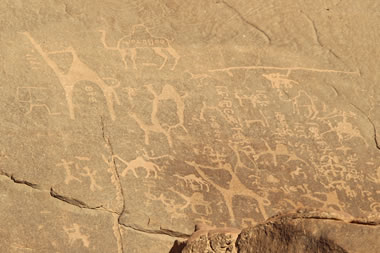
Petroglyphs of a caravan on a rock wall of sandstone in the Wadi Rum Desert of Jordan. This petroglyph is thought to have been made by ancient Nabatean traders who passed through this area, which is along the route of the Silk Road. Image copyright iStockphoto / Andrey Rykov.
Some trivia: The Wadi Rum area is a favorite place for filming scenes of science fiction films that are set on Mars. Learn more in our "Rocks on Mars" article (the last item at the bottom of the page with a fantastic photo of red sand and red sandstone).
| Petroglyphs: Reef Bay, Virgin Islands |
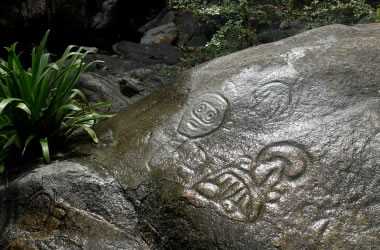
These petroglyphs were photographed at Reef Bay, Virgin Islands. They are thought to have been carved by the Taino people who were all but driven to extinction when the Spanish arrived in the 1600s. Image copyright iStockphoto / Susanna Pershern.
| Petroglyphs: Lousetown Site, Nevada |
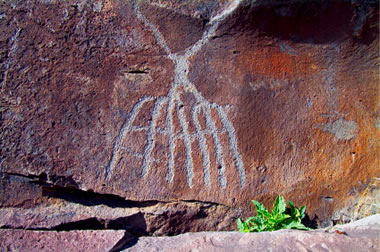
Petroglyph from the Lousetown Site, Nevada. Image copyright iStockphoto / Steven Braun.
| More Rocks |
 |
Tumbled Stones |
 |
Fossils |
 |
Geodes |
 |
The Rock Used to Make Beer |
 |
Topo Maps |
 |
Difficult Rocks |
 |
Fluorescent Minerals |
 |
Sliding Rocks on Racetrack Playa |

Find Other Topics on Geology.com:
|
| ||
|
| ||
|
| ||
|
|