
Home » Metals » REE - Rare Earth Elements
REE - Rare Earth Elements and their Uses
The demand for rare earth elements has grown rapidly, but their occurrence in minable deposits is limited.
Article by: Hobart M. King, PhD, RPG
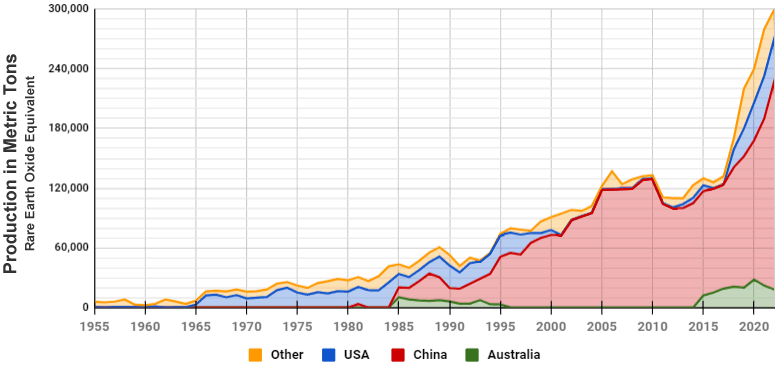
Rare Earth Element Production: This chart shows a history of rare earth element production, in metric tons of rare earth oxide equivalent, between 1950 and 2022. It clearly shows the United States' entry into the market in the mid-1960s when color television exploded demand. When China began selling rare earths at very low prices in the late 1980s and early 1990s, mines in the United States were forced to close because they could no longer make a profit. [1] When China cut exports in 2010, rare earth prices skyrocketed. That motivated new production in the United States, Australia, Russia, Thailand, Malaysia, and other countries. In 2018 production data in Burma / Myanmar became available and boosted the "others" category. Prior to 2018, some production from Burma / Myanmar may have been unreported. Graph by Geology.com using data from United States Geological Survey Mineral Commodity Summaries and other publications.
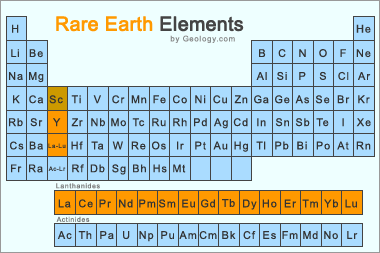
REE Periodic Table: The Rare Earth Elements are the 15 lanthanide series elements, plus yttrium. Scandium is found in most rare earth element deposits and is sometimes classified as a rare earth element. Image by Geology.com.
Table of Contents

What Are Rare Earth Elements (REEs)?
Rare earth elements are a group of seventeen chemical elements that occur together in the periodic table (see image). The group consists of yttrium and the 15 lanthanide elements (lanthanum, cerium, praseodymium, neodymium, promethium, samarium, europium, gadolinium, terbium, dysprosium, holmium, erbium, thulium, ytterbium, and lutetium). Scandium is found in most rare earth element deposits and is sometimes classified as a rare earth element. The International Union of Pure and Applied Chemistry includes scandium in their rare earth element definition.
The rare earth elements are all metals, and the group is often referred to as the "rare earth metals." These metals have many similar properties, and that often causes them to be found together in geologic deposits. They are also referred to as "rare earth oxides" because many of them are typically sold as oxide compounds.
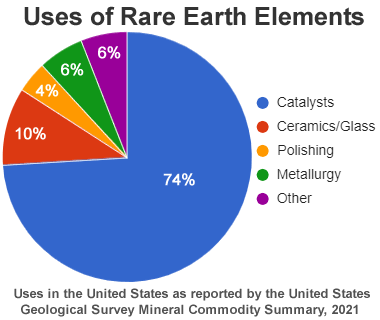
Uses of rare earth elements: This chart shows the use of rare earth elements in the United States during 2021. Many vehicles use rare earth catalysts in their exhaust systems for air pollution control. A large number of alloys are made more durable by the addition of rare earth metals. Glass, granite, marble, and gemstones are often polished with cerium oxide powder. Many motors and generators contain magnets made with rare earth elements. Phosphors used in digital displays, monitors, and televisions are created with rare earth oxides. Most computer, cell phone, and electric vehicle batteries are made with rare earth metals.
Uses of Rare Earth Elements
Rare earth metals and alloys that contain them are used in many devices that people use every day such as computer memory, DVDs, rechargeable batteries, cell phones, catalytic converters, magnets, fluorescent lighting and much more.
During the past twenty years, there has been an explosion in demand for many items that require rare earth metals. Twenty years ago very few people owned a mobile phone, but today over 5 billion people own a mobile device. [3] The use of rare earth elements in computers has grown almost as fast as cell phones.
| |||||||||||||||
Many rechargeable batteries are made with rare earth compounds. Demand for the batteries is being driven by demand for portable electronic devices such as cell phones, readers, portable computers, and cameras.
Several pounds of rare earth compounds are in batteries that power every electric vehicle and hybrid-electric vehicle. As concerns for energy independence, climate change, and other issues drive the sale of electric and hybrid vehicles, the demand for batteries made with rare earth compounds will climb even faster.
Rare earths are used as catalysts, phosphors, and polishing compounds. These are used for air pollution control, illuminated screens on electronic devices, and the polishing of optical-quality glass. All of these products are expected to experience rising demand.
Other substances can be substituted for rare earth elements in their most important uses; however, these substitutes are usually less effective and costly.
From the 1950s until the early 2000s, cerium oxide was a very popular lapidary polish. It was inexpensive and very effective. The recent price increases have almost eliminated the use of cerium oxide in rock tumbling and the lapidary arts. Other types of polish, such as aluminum oxide and titanium oxide, are now used in its place.
Defense Uses of Rare Earth Elements | |
| Lanthanum | night-vision goggles |
| Neodymium | laser range-finders, guidance systems, communications |
| Europium | fluorescents and phosphors in lamps and monitors |
| Erbium | amplifiers in fiber-optic data transmission |
| Samarium | permanent magnets that are stable at high temperatures |
| Samarium | precision-guided weapons |
| Samarium | "white noise" production in stealth technology |
Critical Defense Uses
Rare earth elements play an essential role in our national defense. The military uses night-vision goggles, precision-guided weapons, communications equipment, GPS equipment, batteries, and other defense electronics. These give the United States military an enormous advantage. Rare earth metals are key ingredients for making the very hard alloys used in armored vehicles and projectiles that shatter upon impact.
Substitutes can be used for rare earth elements in some defense applications; however, those substitutes are usually not as effective and that diminishes military superiority. Several uses of rare earth elements are summarized in the accompanying table [6].
 |
Did You Know? Most of the scandium used in the United States goes into aluminum-alloy baseball bats and other sports equipment [4]. Scandium is also used in semiconductors and specialty lighting. Image copyright iStockphoto / Dori OConnell. |
Are These Elements Really "Rare"?
Rare earth elements are not as "rare" as their name implies. Thulium and lutetium are the two least abundant rare earth elements - but they each have an average crustal abundance that is nearly 200 times greater than the crustal abundance of gold [1]. However, these metals are very difficult to mine because it is unusual to find them in concentrations high enough for economical extraction.
The most abundant rare earth elements are cerium, yttrium, lanthanum and neodymium [2]. They have average crustal abundances that are similar to commonly used industrial metals such as chromium, nickel, zinc, molybdenum, tin, tungsten, and lead [1]. Again, they are rarely found in extractable concentrations.
 |
Did You Know? Rare earth magnets are used in wind turbines. Some large turbines require two TONS of rare earth magnets. These magnets are very strong and make the turbines highly efficient. Rare earth magnets are used in turbines and generators in many alternative energy applications. |
 |
Did You Know? Prices and demand for rare earth materials have risen dramatically over the past decade. China produces the majority of the supply. Deposits in Australia and the United States are going back into operation, and exploration in many new areas is progressing. |
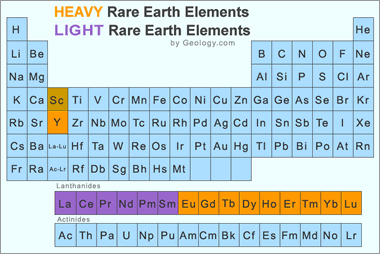
Heavy and light rare earth elements: The rare earth elements are often subdivided into "Heavy Rare Earths" and "Light Rare Earths." Lanthanum, cerium, praseodymium, neodymium, promethium, and samarium are the "light rare earths." Yttrium, europium, gadolinium, terbium, dysprosium, holmium, erbium, thulium, ytterbium, and lutetium are the "heavy rare earths." Although yttrium is lighter than the light rare earth elements, it is included in the heavy rare earth group because of its chemical and physical associations with heavy rare earths in natural deposits.
 |
Did You Know? Every hybrid-electric and electric vehicle has a large battery. Each battery is made using several pounds of rare earth compounds. The use of electric vehicles is expected to increase rapidly, driven by energy independence, climate change and other concerns. This will increase the demand for rare earth materials. Image copyright iStockphoto / Mark Stay. |
 |
Did You Know? Tiny amounts of rare earth metals are used in most small electronic devices. These devices have a short lifespan, and REE recycling is infrequently done. Billions are thrown away each year. Image copyright iStockphoto / Bakaleev Aleksey. |
History of Rare Earth Production and Trade
Pre-1965
Before 1965 there was relatively little demand for rare earth elements. At that time, most of the world's supply was being produced from placer deposits in India and Brazil. In the 1950s, South Africa became the leading producer from rare earth bearing monazite deposits. At that time, the Mountain Pass Mine in California was producing minor amounts of rare earth oxides from a Precambrian carbonatite.
Color Television Ignites Demand
The demand for rare earth elements saw its first explosion in the mid-1960s, as the first color television sets were entering the market. Europium was the essential material for producing the color images. The Mountain Pass Mine began producing europium from bastnasite, which contained about 0.1% europium. This effort made the Mountain Pass Mine the largest rare earth producer in the world and placed the United States as the leading producer.
China Enters the Market
China began producing notable amounts of rare earth oxides in the early 1980s and became the world's leading producer in the early 1990s. Through the 1990s and early 2000s, China steadily strengthened its hold on the world's rare earth oxide market. They were selling rare earths at such low prices that the Mountain Pass Mine and many others throughout the world were unable to compete and stopped operation.
Defense and Consumer Electronics Demand
At the same time, world demand was skyrocketing as rare earth metals were designed into a wide variety of defense, aviation, industrial, and consumer electronics products. China capitalized on its dominant position and began restricting exports and allowing rare earth oxide prices to rise to historic levels.
China as the Largest Rare Earth Consumer
In addition to being the world's largest producer of rare earth materials, China is also the dominant consumer. They use rare earths mainly in manufacturing electronics products for domestic and export markets. Japan and the United States are the second and third largest consumers of rare earth materials. It is possible that China's reluctance to sell rare earths is a defense of their value-added manufacturing sector.
China's Apex of Production Dominance?
The Chinese dominance may have peaked in 2010 when they controlled about 95% of the world's rare earth production, and prices for many rare earth oxides had risen over 500% in just a few years. That was an awakening for rare earth consumers and miners throughout the world. Mining companies in the United States, Australia, Canada, and other countries began to reevaluate old rare earth prospects and explore for new ones.
High prices also caused manufacturers to do three things: 1) seek ways to reduce the amount of rare earth elements needed to produce each of their products; 2) seek alternative materials to use in place of rare earth elements; and, 3) develop alternative products that do not require rare earth elements.
This effort has resulted in a decline in the amounts of rare earth materials used in some types of magnets and a shift from rare earth lighting products to light-emitting diode technology. In the United States, the average consumption of rare earths per unit of manufactured product has decreased, but the demand for more products manufactured with rare earth elements has increased. The result has been higher consumption.
China Buying Resources Outside of China
Chinese companies have been purchasing rare earth resources in other countries. In 2009 China Non-Ferrous Metal Mining Company bought a majority stake in Lynas Corporation, an Australian company that has one of the highest outputs of rare earth elements outside of China. They also purchased the Baluba Mine in Zambia.
World Mine Production and Reserves | ||
| Country | Production (Metric Tons) | Reserves (Metric Tons) |
| United States | 43,000 | 2,300,000 |
| Australia | 18,000 | 4,200,000 |
| Brazil | 80 | 21,000,000 |
| Burma | 12,000 | not available |
| Canada | -- | 830,000 |
| China | 210,000 | 44,000,000 |
| Greenland | -- | 1,500,000 |
| India | 2,900 | 6,900,000 |
| Madagascar | 960 | not available |
| Russia | 2,600 | 21,000,000 |
| South Africa | -- | 790,000 |
| Tanzania | -- | 890,000 |
| Thailand | 7,100 | not available |
| Vietnam | 4,300 | 22,000,000 |
| Other Countries | 80 | 280,000 |
| World total (rounded) | 300,000 | 130,000,000 |
Rare Earth Production Outside of China
Mines in Australia began producing rare earth oxides in 2011. In 2012 and 2013 they were supplying about 2% to 3% of world production. In 2012 the Mountain Pass Mine came back into production, and the United States produced about 4% of the world's rare earth elements in 2013. Production in Brazil, Malaysia, Russia, Thailand and Vietnam continued or increased.
New mineral resource assessments conducted by the United States Geological Survey identified significant resources outside of China. Although China is the world leader in rare earth production, they only control about 36% of the world's reserves. This provides an opportunity for other countries to become important producers now that China is not selling rare earth materials below the cost of production.
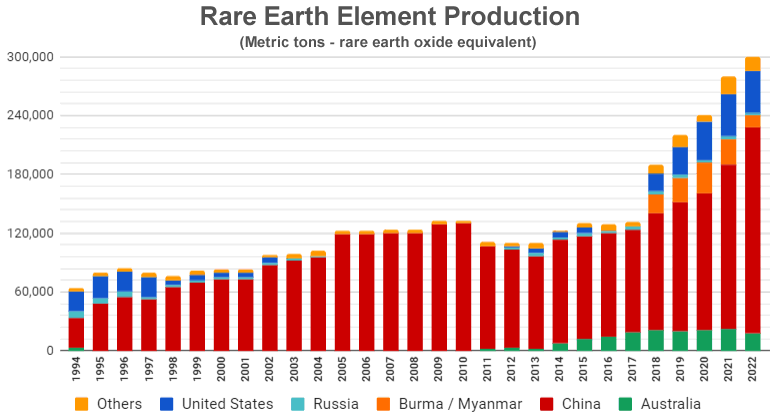
REE Production Chart: This chart shows China's dominance in the production of rare earth elements between 1994 and 2022. The United States was a significant producer through the 1990s, but low-priced materials sold by China forced mines in the United States and other countries out of operation. As China limited exports, and prices increased rapidly in 2009 and 2010, mines in Australia and the United States became active again. In 2018, data from Burma / Myanmar became available, causing an increase in production that may have been present but unreported prior to 2018. Graph by Geology.com using data from the United States Geological Survey.
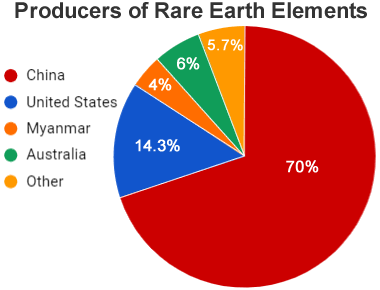
Producers of Rare Earth Elements: This pie chart shows the world's major producers of rare earth elements. Countries which fall into the "other" category include India, Madagascar, Vietnam, Russia, and Brazil. Image by Geology.com using data from the United States Geological Survey.
Dangers of a Dominant World Producer
Supply and demand normally determine the market price of a commodity. As supplies shrink, prices go up. As prices go higher, those who control the supply are tempted to sell. Mining companies see high prices as an opportunity and attempt to develop new sources of supply.
With rare earth elements, the time between a mining company's decision to acquire a property and the start of production can be several years or longer. There is no fast way to open a new mining property.
If a single country controls almost all of the production and makes a firm decision not to export, then the entire supply of a commodity can be quickly cut off. That is a dangerous situation when new sources of supply take so long to develop.
In 2010 China significantly restricted their rare earth exports. That was done to ensure a supply of rare earths for domestic manufacturing and for environmental reasons. This shift by China triggered panic buying, and some rare earth prices shot up exponentially. In addition, Japan, the United States, and the European Union complained to the World Trade Organization about China's restrictive rare earth trade policies.
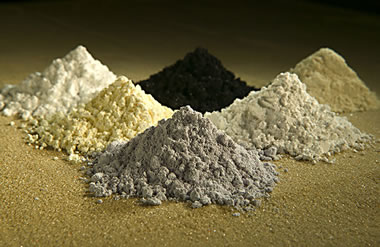
Rare earth oxides: These rare earth oxides are used as tracers to determine which parts of a watershed are eroding [5]. Clockwise from top center: praseodymium, cerium, lanthanum, neodymium, samarium, and gadolinium. Image by Peggy Greb, USDA image gallery.
World Rare Earth Mineral Resources
"Rare earths are relatively abundant in the Earth's crust, but discovered minable concentrations are less common than for most other ores. U.S. and world resources are contained primarily in bastnäsite and monazite. Bastnäsite deposits in China and the United States constitute the largest percentage of the world's rare-earth economic resources, while monazite deposits in Australia, Brazil, China, India, Malaysia, South Africa, Sri Lanka, Thailand, and the United States constitute the second-largest segment.
Apatite, cheralite, eudialyte, loparite, phosphorites, rare-earth-bearing (ion adsorption) clays, secondary monazite, spent uranium solutions, and xenotime make up most of the remaining resources. Undiscovered resources are thought to be very large relative to expected demand." Quoted from the United States Geological Survey's Mineral Commodity Summary [9].
| Rare Earth Element References |
|
[1] Rare Earth Elements - Critical Resources for High Technology: United States Geological Survey, Fact Sheet 087-02.
[2] The Rare-Earth Elements - Vital to Modern Technologies and Lifestyles: Bradley S. Van Gosen, Philip L. Verplanck, Keith R. Long, Joseph Gambogi, and Robert R. Seal II, United States Geological Survey Fact Sheet 2014-3078, November 2014. [3] Smartphone Ownership Is Growing Rapidly Around the World, but Not Always Equally: Laura Silver, Pew Research Center, article on the Pew Research Center website, February 2019. [4] Scandium: Daniel J. Cordier, United States Geological Survey, Mineral Commodity Summaries, January 2022. [5] A Rare-Earth Approach to Tracing Soil Erosion: United States Department of Agriculture, Agricultural Research Service. [6] China's Ace in the Hole: Rare Earth Elements: Cindy A. Hurst, National Defense University Press. [7] The Geology of Rare Earth Elements: Republication of "The Principal Rare Earth Elements Deposits of the United States - A Summary of Domestic Deposits and a Global Perspective." [8] Rare Earth Elements and National Security: Eugene Gholz, Council on Foreign Relations Energy Report, 2014. [9] Rare Earths: James B. Hedrick, United States Geological Survey, Mineral Commodity Summaries, January 2008. [10] Rare Earths: Daniel J. Cordier, United States Geological Survey, Mineral Commodity Summaries, January 2023. |
Rare Earth Element Outlook
The global demand for automobiles, consumer electronics, energy-efficient lighting, and catalysts is expected to rise rapidly over the next decade. Rare earth magnet demand is expected to increase, as is the demand for rechargeable batteries. New developments in medical technology are expected to increase the use of surgical lasers, magnetic resonance imaging, and positron emission tomography scintillation detectors.
Rare earth elements are heavily used in all of these industries, so the demand for them should remain high.



Find Other Topics on Geology.com:
|
| ||
|
| ||

|
| ||

|
|