
Geological Terms Beginning With "N"
For terms beginning with other letters, please click below
|
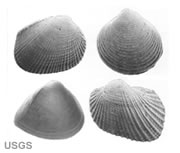
Nannofossils
A generic term used in reference to very small fossils that are at the limit of resolution by a light microscope. They are therefore studied with electron microscopes. Discoasters and coccoliths are frequently called "nannofossils."
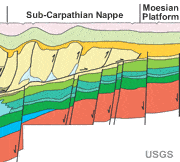
Nappe
A large slab of Earth's surface that has been moved in a horizontal or near horizontal direction through thrust faulting or recumbent folding. The term is generally used for very large slabs which are many square kilometers or miles in surface area.

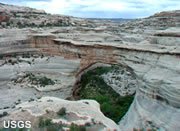
Natural Bridge
Any arch-shaped rock formation produced by weathering and/or erosion that spans a small valley. Some natural bridges are formed when the bend of a meandering stream erodes through a meander neck. In limestone areas, they can form when cavern collapse leaves a small area of roof spanning a passage. The photo shows Sipapu Bridge at Natural Bridges National Monument in Utah.

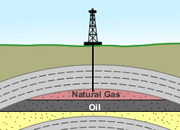
Natural Gas
Naturally occurring hydrocarbons that exist in subsurface rock units in the gaseous state. Methane is the most abundant, but ethane, propane, and others also occur. Natural gas is flammable and is burned as a fuel. Natural gas has many uses beyond being burned as a fuel. These include making a wide variety of chemical, plastic, and fertilizer products.
Natural Gas Flaring
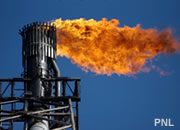
The practice of burning natural gas at a well site where oil is being produced but there is no opportunity to collect the associated natural gas for profitable use. This is a waste of a natural resource, a pollution without benefits, and a loss of landowner royalties. Flaring occurs extensively over the Bakken Formation of North Dakota, where enormous amounts of oil are being produced but there are no pipelines for natural gas. Offshore oil fields often flare natural gas for the same reason. The photo shows natural gas flaring at a Marcellus Shale well site in Pennsylvania. Flaring in many gas fields is so common that it can be seen from space.
Natural Gas Liquids
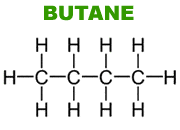
Components of natural gas other than methane that are in the gaseous state under the high temperatures and pressures of the subsurface reservoir, but when they are produced at the lower temperatures and pressures of the surface condense into a liquid. These "condensates" vary in composition and abundance from one well to another and even from one formation to another in the same well. They can include hydrocarbons such as pentane, butane, propane, hexane and others. These liquids are separated from the raw gas and have commercial value. In some areas they are more valuable than the methane that is produced. Raw natural gas that contains natural gas liquids is known as "wet gas."
Natural Levee
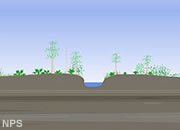
A mound of sediment that parallels a stream channel, forming a levee-like deposit. When flood waters leave the normal stream channel and enter the flood plain, there is a rapid reduction of velocity that causes suspended sediments to fall to the bottom immediately after leaving the channel. This deposition is what produces the levee.
Natural Reservoir Pressure
The pressure within an oil or gas reservoir that forces oil or gas up the well bore when the reservoir is penetrated by drilling.
Neap tide
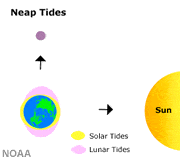
A daily tidal range of minimal amplitude that occurs when the moon and sun are positioned at 90 degrees to one another. In this moon-earth-sun configuration, the gravitational attraction of the moon and sun compete for Earth's water. Neap tide occurs at the first and third quarters of the moon. See spring tide for contrast.

Nebula
A cloud of interstellar dust and gas in outer space that is faintly visible in the night sky from Earth. Shown in the photo is the Helix Nebula.
Neutron
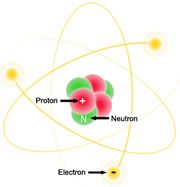
A subatomic particle contained in the nucleus of an atom. It has no electrical charge and a mass similar to that of a proton.
Nodule
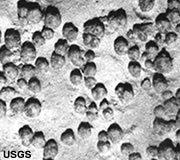
A mineral mass that has a different composition or is more resistant to weathering than its surrounding rock. These are normally rounded in shape. Examples include chert masses in a limestone rock unit, pyrite masses in a coal seam, or carbonate masses in a shale. In most cases, these "nodules" have formed within the rock unit or its former sediment mass. One of the most widely known types of nodules are Oregon Thundereggs, agate nodules with concentric banding that might have horizontal banding and drusy quartz in the center. The term is also applied to rounded masses of manganese minerals that occur on some parts of the ocean floor. The photo shows iron-manganese nodules on the seafloor north of the Puerto Rico Trench at a depth of about 5339 meters. The nodules are about two to four centimeters in diameter.
Non-Operating Interest
A mineral lease interest that does not involve the rights and responsibilities of exploration, development, or production. A royalty interest is a non-operating interest.
Non-Point Source Pollution
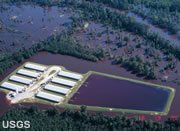
Pollution that does not originate at a single location. In an urban area, runoff water can be polluted while flowing toward a stream by gasoline, antifreeze, road salt, or other contaminants. In rural areas, runoff can be contaminated by insecticides, manure, or fertilizer. This contamination can be significant but cannot be traced back to a specific source. The photo shows flooding in Wayne County, North Carolina. Flooding in a rural area can mobilize fertilizer, animal waste, and many other pollutants.
Non-Producing
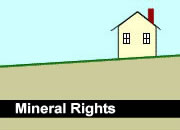
A term that refers to a property, a well, or a mine from which commercial amounts of a mineral resource have not yet been produced.
 All scientific disciplines have an essential vocabulary that students and professionals must understand to learn and communicate effectively. A geology dictionary that is used regularly is one of the most important tools for developing professional competence. A good dictionary should be on the desk of every geologist and within easy reach. This dictionary is compact and inexpensive at only $19.99. More information. |
 |
Normal Fault
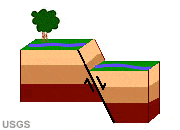
A fault with vertical movement and an inclined fault plane. The block above the fault has moved down relative to the block below the fault. The dip angle of the fault plane is between 45 and 90 degrees. Normal faults are the typical structural style of divergent plate boundaries and portions of the crust under extensional stress such as the East Africa Rift.
Nuclear Electric Power (Nuclear Power)
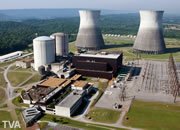
The generation of electricity using the heat released from a nuclear fuel. Shown in the photo is the Bellefonte Nuclear Generating Station, located near Hollywood, Alabama.

Nuclear Fuel
Fissionable materials that are rich enough to sustain a fission chain reaction.
Nuclear Reactor
A facility where a nuclear fission chain reaction can be initiated, controlled, and sustained. Shown in the photo is the Bellefonte Nuclear Generating Station, located near Hollywood, Alabama. The reactors are located in the two cylindrical structures on the left side of the photo. The two hourglass-shaped structures are cooling towers.
|
| More General Geology |
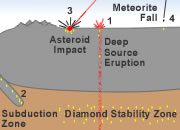 |
Diamonds from Coal? |
 |
What is a Geyser? |
 |
What is the San Andreas Fault? |
 |
The Doorway to Hell |
 |
Topo Maps |
 |
Igneous and Volcanic Features |
 |
Gifts That Rock |
 |
Geology Dictionary |

Find Other Topics on Geology.com:
|
| ||
|
| ||
|
| ||
|
|