
Topaz
A gemstone that occurs in a wide range of natural and treated colors.
Author: Hobart M. King, PhD, GIA Graduate Gemologist
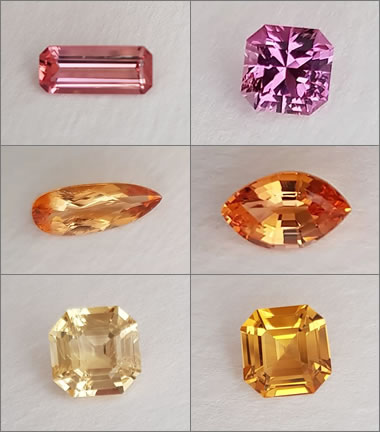
Natural Topaz Colors: A collection of faceted topaz in a variety of colors. Starting at the bottom is yellow topaz, sometimes called "golden topaz". In the middle is orange topaz. Some gemologists would call these two specimens "imperial topaz" because they display reddish orange pleochroic colors on both ends of the gem. At the top are orangy pink and purplish pink gems that are sometimes called "pink topaz". The rarity and value of these natural topaz colors is lowest at the bottom of the photo and highest at the top. Specimens and photos by Lockwood and Sloan.
What is Topaz?
Topaz is a rare silicate mineral with a chemical composition of Al2SiO4(F,OH)2. It is best known for being these four things:
- one of the most popular colored stones
- number "8" in the Mohs Hardness Scale
- a birthstone for the month of November
- a gemstone of many colors
Topaz obtains much of its popularity from its beautiful colors and its status as a birthstone.
Natural topaz colors include rare and valuable yellow, orange, pink, red, purple, and blue. The most affordable and frequently purchased are blue topaz and mystic topaz that have received their colors from treatment.
In 1812, Friedrich Mohs developed a set of 10 standard minerals that could be used to assign a relative hardness to minerals and other materials. Today, over 200 years later, his hardness scale is still used by students and geologists throughout the world to identify mineral specimens.
Table of Contents

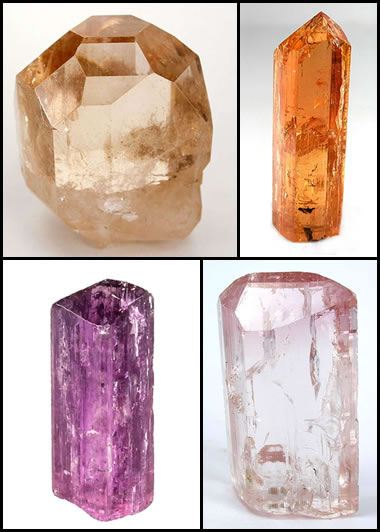
Colored Topaz Crystals: A collection of topaz crystals of various natural colors - sherry, imperial, pink, and light purple. Most topaz crystals are colorless. Most topaz in commercial jewelry has been heated, irradiated, or coated to improve its color. Specimens and photos by Arkenstone / www.iRocks.com
Topaz - The November Birthstone
Topaz is the original modern birthstone for the month of November. Its status as a traditional birthstone contributes significantly to the gem's popularity and is the reason behind many sales. Topaz jewelry is sold in almost every jewelry store in the United States.
In 1952, Jewelers of America made a few modifications to the list of modern birthstones. That was when citrine, a yellow to orange to reddish brown variety of quartz, was added as a second birthstone for the month of November.
Physical Properties of Topaz |
|
| Chemical Classification | Silicate. |
| Color | Natural colors include: colorless, yellow, orange, brown, red, pink, blue, green. Occurs in a wide range of treated colors, most often blue. |
| Streak | Colorless - harder than the streak plate. |
| Luster | Vitreous. |
| Diaphaneity | Translucent to transparent. |
| Cleavage | Perfect basal cleavage. |
| Mohs Hardness | 8 |
| Specific Gravity | 3.4 to 3.6 |
| Diagnostic Properties | Hardness, prismatic crystals, sometimes striated, cleavage, specific gravity. |
| Chemical Composition | Al2SiO4(F,OH)2 |
| Crystal System | Orthorhombic. |
| Uses | Gemstone, Mohs hardness index mineral. |
Physical Properties of Topaz
One of the best-known physical properties of topaz is its hardness. It has a hardness of 8 on the Mohs hardness scale, making it the hardest silicate mineral. Every student who takes a physical geology course learns about the exceptional hardness of topaz. Diamond, corundum, and chrysoberyl are the only commonly known minerals that are harder than topaz.
Topaz occurs in a wide range of colors. The most valuable colors for use in jewelry are natural pink, orange, red, purple and blue. These colors are very rare.
The most common natural colors of topaz are colorless (often called "white topaz"), pale yellow, and brown. While these colors are not often used in jewelry in their natural state, they can be treated in a variety of ways to produce colors that are much more desirable.
When allowed to grow in an unrestricted cavity, topaz forms orthorhombic crystals, often with striations that parallel the long axis of the crystal. It also has a distinct basal cleavage that breaks to form vitreous fracture surfaces perpendicular to the long axis of the crystal. This cleavage makes topaz a more fragile gemstone than its hardness of 8 would imply. Topaz is very hard, but it has a low tenacity, which means it chips and cleaves easily.
Topaz has a specific gravity that ranges between 3.4 and 3.6. This is surprisingly high for a mineral composed of aluminum, silicon, and gaseous elements. This high specific gravity causes it to be concentrated into placer deposits by stream currents.
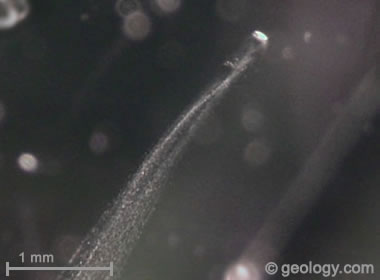
Comet Tail Inclusion in Topaz: It looks like a comet flying through a gemstone. Instead it is a tiny crystal of an unidentified mineral that started to grow on the surface of a much larger topaz crystal. The tiny crystal made it difficult for the topaz below it to grow properly - it had become an obstacle to growth. But, as the topaz crystal expanded, it pushed the tiny crystal in the direction of growth, and a wispy stream of inclusions within the topaz was the result.
What Color is Topaz?
Topaz occurs in a wide range of natural colors; however, most natural topaz is colorless. The most highly regarded colors are the reds and pinks, which receive their color from trace amounts of chromium. Chromium is also responsible for the color in violet and purple topaz.
A variety known as "imperial topaz" is especially valuable because people enjoy its reddish orange to orangy red colors, which often both occur in the same crystal. Most of the world's imperial topaz is found in Brazil.
Topaz with a natural blue color is very rare and valuable. Topaz that is yellow, brown, and colorless has a much lower value. However, some natural topaz with these colors can be heated, irradiated, coated, or treated in other ways to alter their color. The fastest selling colors of topaz are varieties of blue that are treated by a process known as irradiation. We explain this process in detail on our blue topaz page.
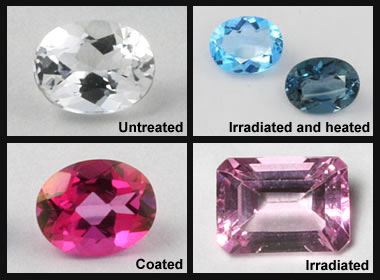
Topaz Treatment Methods: Colorless topaz, also known as white topaz, (top left) can be irradiated and heated to produce gems with a blue color (top right). Irradiation alone can produce a pale pink color (bottom right). Coating with certain metallic oxides can produce a vivid pink color (bottom left). Most topaz in commercial jewelry today is colorless material that has been heated, irradiated, or coated to improve its color.
Use of Topaz as a Gemstone
The name "topaz," and variants of the name in other languages, have been used for yellowish gemstones for at least two thousand years. At that time yellowish gems were called "topaz" in many parts of the world. Many of the earliest gem traders did not realize that these yellowish stones were actually different materials.
Then, about two hundred years ago, people who traded in gems began to realize that these yellowish gems might be topaz, quartz, beryl, olivine, sapphire, or one of many other minerals. They also learned that topaz occurred in a wide range of colors other than yellow.
If you visited a jewelry store as recently as fifty years ago and asked to see topaz jewelry, you would likely have been shown gems that were in the color range of yellow, orange, and brown. Those were the common colors of topaz being sold at that time.
Then, starting in the 1970s and 1980s, the most common color that you would be shown began to be a beautiful blue. This blue color was usually produced by treatments that converted colorless topaz into a more marketable gemstone.
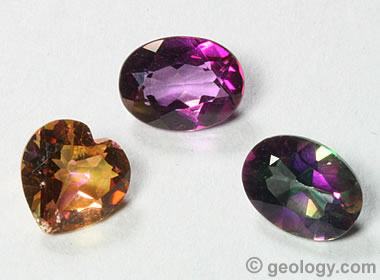
"Mystic" Topaz: Some topaz is heated and then coated with a metallic oxide to change its color or to produce an iridescent effect. These treatments are sold under the trade name of "mystic topaz." These materials are simply clear topaz with a coating that might not be very durable.
Topaz Treatments
Today most topaz offered in department stores and mall jewelry stores at low to moderate prices has been treated in a laboratory. Colorless topaz can be heated, irradiated, and coated with thin layers of metallic oxides to alter its color.
Natural blue topaz is extremely rare and is usually pale blue. Almost all of the blue topaz offered in stores today is colorless topaz that has been irradiated and then heated to produce a blue color. "Swiss blue" and "London blue" are trade names for two of the most common varieties of treated blue topaz seen in today's market. These colors have caused the popularity of topaz to soar!
Natural pink to purple topaz is also extremely rare, but these colors can be produced in a laboratory as well. The starting point is a stone cut from colorless topaz. It is first heated and then coated with a layer of metallic oxide to produce the pink color. If coated stones are worn in jewelry, over time the coating can wear thin or wear through at points on the stone where abrasion occurs.
Some topaz is coated with a metallic oxide that gives the stone a multicolored iridescent luster. These stones, known as "mystic topaz," appear to change color if the observer moves the stone under a light or changes the angle of observation. These coatings are also thin and can be worn through during normal wear.
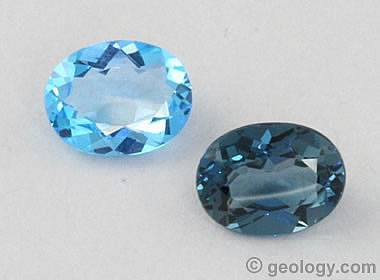
Blue Topaz: Faceted ovals of two colors of blue topaz that are popular today. On the left is a "Swiss Blue" topaz weighing 2.02 carats. On the right is a "London Blue" weighing 2.26 carats. Both stones were colorless topaz mined in Brazil. After faceting they were irradiated and heated to produce the blue colors. Blue topaz with a color produced by treatment is the most common color of topaz in commercial jewelry today - and its low price makes it incredibly popular.
Is it dangerous to wear blue topaz? The NRC has no reason to believe that wearing irradiated gemstones can be harmful. There have been no reported cases of anyone being harmed by wearing them. There is no safety reason to stop wearing blue topaz or any other irradiated gems. Do I need a license to sell blue topaz or other irradiated gems? Probably not. NRC regulations cover material made radioactive in a nuclear reactor or linear accelerator. The initial transfer of these materials must be done under an NRC distribution license. Once the radioactivity levels fall below certain limits, the materials become "exempt" from further regulation. This means no license is needed to buy or to resell them. So individual jewelers do not need to be licensed as long as they receive their stones from an NRC licensee. |
Radioactive Blue Topaz?
The type of irradiation used to transform colorless topaz into blue topaz can cause the irradiated material to become slightly radioactive. Fortunately, the radioactivity level of the topaz begins to decline as soon as treatment is complete. It eventually declines to a level that is safe for the topaz to be handled during manufacturing and be sold to the public in jewelry.
In the United States, the Nuclear Regulatory Commission requires all irradiated gems and gem materials to be securely stored until their radioactivity decays to a level that is safe for manufacturing and sale. This is done to protect employees of the gem and jewelry industry and the jewelry-buying public.
All companies who distribute newly irradiated gems in the United States must be licensed by the Nuclear Regulatory Commission. They must also conduct radiological surveys of all materials in secure storage to be sure that no gems are released until their radioactivity declines to a level that will not pose any health risks.
The Nuclear Regulatory Commission has detailed information about irradiated topaz and other gemstones on their website. They also have answers to frequently asked questions. Two answers that we believe will be of interest to our readers are quoted in the box on this page. You can read the rest by visiting the NRC website.
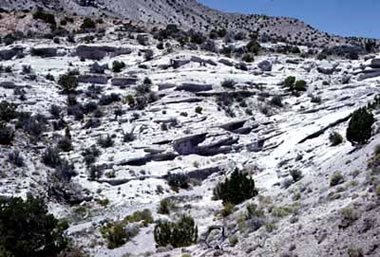
Topaz Mountain Rhyolite: Outcrop of stratified tuff of the Topaz Mountain Rhyolite, filling a paleovalley in western Utah. These valley fills were once thought to be deposited by water, but now many of them are believed to have been deposited by ground surges of hot ash. The Topaz Mountain Rhyolite has many vuggy areas, which often contain champagne-colored topaz crystals. USGS image.
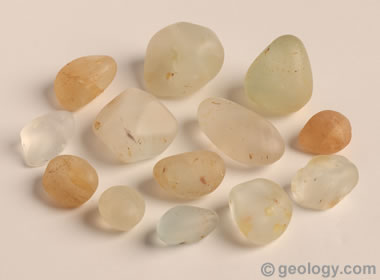
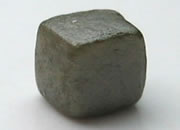
Placer Topaz: Topaz has a high specific gravity, and because of that it is commonly concentrated by stream currents into placer deposits. Much topaz has been produced from placer deposits in Brazil and Nigeria. The topaz pebbles in the photo above are from Brazil and were rounded and frosted during stream transport.
Geologic Occurrence of Topaz
Topaz has a chemical composition of Al2SiO4(F,OH)2. The fluorine in its composition is a limiting factor on its formation. Fluorine gas in concentrations high enough to form minerals only occurs in a few geologic environments.
Most topaz grows as crystals within the veins and voids of igneous rocks. This topaz is found in the cavities of a pegmatite, or in the vesicles and intergranular spaces of rhyolite. These topaz crystals grow during the late stages of magma cooling and while degassing releases the fluorine necessary for topaz crystal growth.
Precipitating in cavities, topaz sometimes develops nicely formed crystals. These crystals can have excellent clarity and can be used as a gem material. Many mineral collectors enjoy collecting gem-quality topaz crystals because they have the value of an excellent mineral specimen plus (if they are of rare color) the value of a gem material.
Topaz is also found as water-worn pebbles in stream sediments derived from the weathering of pegmatites and rhyolites. These are often produced by placer mining.
Sources of Topaz
Topaz is found in many locations worldwide where rocks like pegmatite and rhyolite are formed. Here, topaz is usually a minor mineral in terms of quantity, and a secondary mineral in terms of its time of formation.
Brazil has been the world's most important source of topaz for decades. Almost all of the world's fine-quality imperial topaz is produced in the state of Minas Gerais in southeastern Brazil. The Ouro Preto and Capao mines have been the most important sources of yellow, orange, pink, red and violet topaz crystals for the gem and mineral specimen markets. Brazil is also the leading producer of colorless topaz, much of which is heat treated and irradiated to produce the colors of Swiss blue and London blue.
Pakistan is a smaller but noteworthy source of pink, red and violet topaz. Sri Lanka is a very important source of colorless topaz. Other sources of topaz include: Australia, India, Madagascar, Mexico, Myanmar, Namibia, Nigeria, Russia, and Zimbabwe. In the United States, some topaz is produced in Utah, where it was named the state gemstone in 1969.
Topaz Misnomers
The name "topaz" has often been used incorrectly or inappropriately in conversation and commerce. These incorrect uses of a name are called "misnomers". Misnomers can be used in three ways:
- in innocent ways when the person using the name lacks understanding
- in misleading ways to build perceived value in a low-value material
- in derogatory ways to disparage a product
The word topaz is used in all of the above ways and perhaps more. A list of topaz misnomers is provided below with a brief description for each misnomer. Many of them are archaic, but they can still be encountered in writings and discussions. Professionals in the gem and jewelry industry should avoid the use of these terms and use proper mineral species and variety names.
"Brazilian Ruby" is a misnomer used for pink or reddish topaz with either a natural color or a color that is produced by treatment.
"Brazilian Sapphire" is a misnomer used for blue or green topaz, and sometimes for blue tourmaline.
"Indian Topaz" is a misnomer used for citrine, a yellow color variety of quartz.
"Madeira Topaz" is a misnomer used for dark citrine, the dark yellow, orangy, or reddish brown color varieties of quartz.
"Occidental Topaz" is a misnomer used for citrine, a yellow color variety of quartz.
"Oriental Topaz" is a misnomer used for yellow sapphire, the yellow color variety of the mineral corundum.
"Smoky Topaz" is a misnomer used for smoky quartz, the yellowish brown to brown variety of quartz.
"Spanish Topaz" is a misnomer used for brownish red citrine from Spain which has been heat treated to a red-orange color.
"Topaz Cat's-Eye" is a misnomer used for a yellow color variety of sapphire that displays chatoyancy.
"Topaz Glass" is a misnomer used for glass made in one of the many color varieties of topaz.
"Topaz Quartz" is a misnomer used for smoky quartz, the dark yellow to yellowish brown to brown varieties of quartz. It is especially used when these materials are produced by heat treating amethyst.
"Topaz Saffronite" is a misnomer used for citrine, the yellow color variety of quartz.
The Federal Trade Commission, in their new edition of Guides for the Jewelry, Precious Metals, and Pewter Industries, clearly indicates that using incorrect varietal names can be misleading and deceptive. Incorrect varietal names are misnomers. A vendor who uses them as product names, or in product promotion, descriptions, labels, etc. might incur civil or criminal liability. For that reason, it is best to avoid misnomers completely. The Federal Trade Commission used the names "green amethyst" and "yellow emerald" as examples of names that are problematic.
| More Gemstones |
 |
Birthstones |
 |
Diamond |
 |
Blue Gemstones |
 |
100+ Gems |
 |
Green Gemstones |
 |
Mined in America |
 |
Ruby and Sapphire |
 |
Ethiopian Opal |

Find Other Topics on Geology.com:
|
| ||
|
| ||

|
| ||

|
|