Home » Rocks » Metamorphic Rocks » Amphibolite
Amphibolite
A metamorphic rock composed primarily of amphibole minerals and plagioclase feldspar
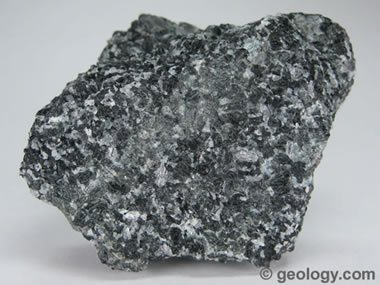
Amphibolite: Amphibolite is a coarse-grained metamorphic rock that has amphibole minerals such as the hornblende group as its primary ingredient. The specimen shown is about two inches (five centimeters) across.
What is Amphibolite?
Amphibolite is a coarse-grained metamorphic rock that is composed mainly of green, brown, or black amphibole minerals and plagioclase feldspar. The amphiboles are usually members of the hornblende group. It can also contain minor amounts of other metamorphic minerals such as biotite, epidote, garnet, wollastonite, andalusite, staurolite, kyanite, and sillimanite. Quartz, magnetite, and calcite can also be present in small amounts.
How Does Amphibolite Form?
Amphibolite is a rock of convergent plate boundaries where heat and pressure cause regional metamorphism. It can be produced through the metamorphism of mafic igneous rocks such as basalt and gabbro, or from the metamorphism of clay-rich sedimentary rocks such as marl or graywacke. The metamorphism sometimes flattens and elongates the mineral grains to produce a schistose texture.
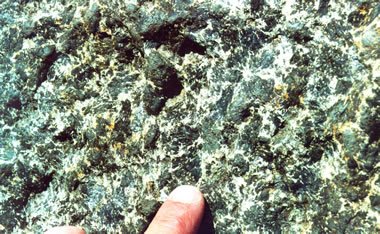
Amphibolite: Some amphibolites are greenish, as determined by the color of the amphibole minerals. This specimen is actually an igneous rock. Some geologists call an igneous rock composed primarily of amphibole minerals an amphibolite or "hornblendite." USGS image.
Uses of Amphibolite
Amphibolite has a variety of uses in the construction industry. It is harder than limestone and heavier than granite. These properties make it desirable for certain uses. Amphibolite is quarried and crushed for use as an aggregate in highway construction and as a ballast stone in railroad construction. It is also quarried and cut for use as a dimension stone.
Higher quality stone is quarried, cut, and polished for architectural use. It is used as facing stone on the exterior of buildings, and used as floor tile and panels indoors. Some of the most attractive pieces are cut for use as countertops. In these architectural uses, amphibolite is one of the many types of stone sold as "black granite."
Some amphibolite deposits, such as the one at Gore Mountain in the Adirondacks of New York, contain significant amounts of garnet. If enough garnet is present and of proper quality, the amphibolite can be mined and the garnet recovered for use as an abrasive.
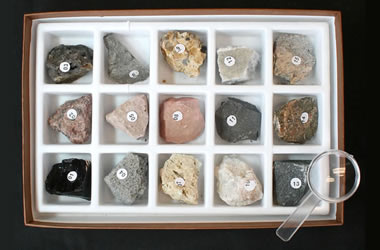
Rock & Mineral Kits: Get a rock, mineral, or fossil kit to learn more about Earth materials. The best way to learn about rocks is to have specimens available for testing and examination.

Find Other Topics on Geology.com:
 | Rocks: Galleries of igneous, sedimentary and metamorphic rock photos with descriptions. |
|
 | Minerals: Information about ore minerals, gem materials and rock-forming minerals. |
|
 | Volcanoes: Articles about volcanoes, volcanic hazards and eruptions past and present. |
|
 | Gemstones: Colorful images and articles about diamonds and colored stones. |
|
 | General Geology: Articles about geysers, maars, deltas, rifts, salt domes, water, and much more! |
|
 | Geology Store: Hammers, field bags, hand lenses, maps, books, hardness picks, gold pans. |
|

|
 | Diamonds: Learn about the properties of diamond, its many uses, and diamond discoveries.
|
|