
Home » Minerals » Diamond » Natural Diamond Production Map
Which Countries Produce the Most Gem Diamonds?
Once centered in Africa, diamond mining now occurs in many countries around the world.
Article by: Hobart M. King, PhD, RPG
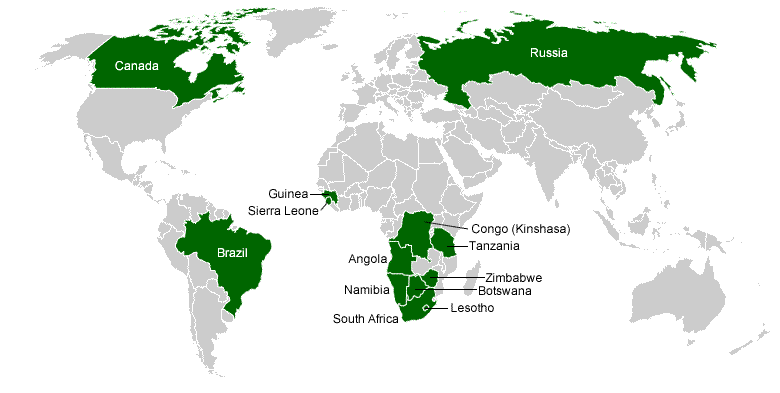
Diamond-producing countries: This map shows countries with at least 100,000 carats of natural gem-quality diamond production in 2023. The map clearly shows that natural diamond production occurs in many parts of the world. Map by Geology.com and MapResources. Data from USGS Mineral Commodity Summaries. [1]
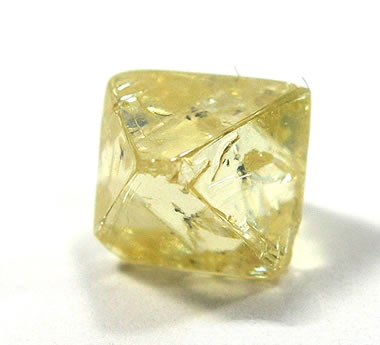
Rough diamond: A transparent yellow diamond of approximately three carats from a mine in Kimberly, North Cape Province, South Africa. Many natural diamond specimens exhibit an octahedral crystal form. Specimen and photo by Arkenstone / www.iRocks.com.
Diamond Producers and Consumers
Most of the world's natural gem-quality diamonds are mined in countries where citizens do not purchase a lot of diamond jewelry. The leading consumers of diamond jewelry include the United States, India, China, the European Union, Japan, Hong Kong, and the Middle East.
The United States consumes over 40% of the world's diamond jewelry. The other areas listed combined consume another 40% of the world's diamond jewelry. But, none of these areas are even close to being important miners of natural gem-quality diamonds. [2]
Table of Contents

Where Are Diamonds Mined?
Since the 1870s, most of the world's gem-quality diamonds have been mined in Africa. The diamond production map above shows countries with at least 100,000 carats of natural gem-quality diamond production.
The map illustrates that in recent decades, diamond production has spread to many parts of the world. Diamond production in Russia and Canada has grown rapidly, and these countries currently produce over half of the world's diamonds. However, the core of natural gem-quality diamond production remains in Africa.
The Leading Diamond Producers
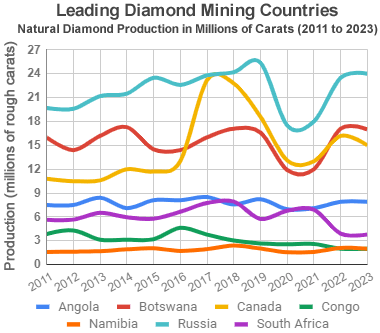
Natural Diamond Producers: This graph shows the history of natural, gem-quality, rough diamond production for the world's top seven diamond-producing countries between 2011 and 2023. Production levels at many mines were reduced in 2020 and 2021 by COVID-19 and supply chain problems. This data suggests that in 2022 and 2023, diamond production levels in Russia were not throttled by international sanctions. Graph by Geology.com. All data are estimates of rough diamond production from USGS Mineral Commodity Summaries [1], USGS Minerals Yearbook [2], Natural Resources Canada, and Kimberley Process participants.
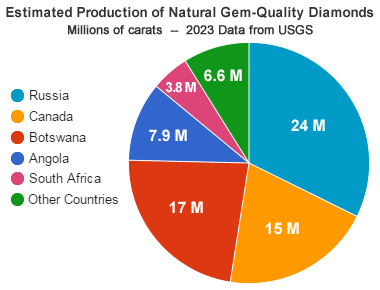
World Diamond Production: The chart above shows estimated production levels of natural gem-quality diamonds in countries mining at least three million carats in 2023. See accompanying table for estimated diamond production for "Other Countries". Graph by Geology.com. Estimates from USGS Mineral Commodity Summaries [1].
| |||||||||||||||||||||||||||||||||||
Beyond the dominant producers, numerous countries produce less than one million carats per year, but are regular, consistent producers. These countries include: Guinea, Lesotho, Sierra Leone, and Zimbabwe.
They each produce over 100,000 carats of gem-quality diamonds per year and have averaged at least that much for the past decade. This production comes from smaller mechanized mines or an enormous number of artisanal workers in alluvial deposits. Recent production can be seen in the accompanying table.
The Argyle Mine in Australia was once the world's leading diamond producer on the basis of carat weight. It produced enormous numbers of brown diamonds. These were initially used as industrial diamonds, but many of them were later cut into tiny faceted gems which became popular in pavé-set jewelry. Argyle was also a leading source for colored diamonds, especially reds, pinks, blues, and violets.
Are Russian Diamonds Conflict Diamonds?Russia produces more diamonds than any other country (on the basis of carat weight). Almost all of their diamonds are produced by ALROSA, a diamond mining and manufacturing company that is 1/3 owned by the Russian government. Most ALROSA diamonds are exported, and that provides a significant source of revenue for the Russian government. Atrocities committed by Russia, in its war against Ukraine, have motivated the State Gemological Centre of Ukraine to ask the Kimberley Process to redefine the term "conflict diamonds" in a way that will reduce the demand for Russian diamonds. Learn more. |
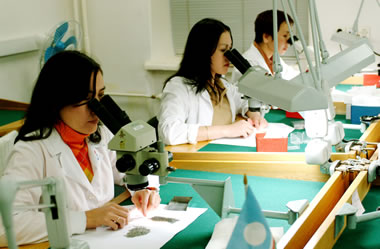
Diamond sorting: ALROSA produces over 20 million carats of rough diamonds every year, and most of those diamonds are a fraction of a carat in size. An army of gemologists is required to sort that tremendous quantity of small rough. Image provided by ALROSA.
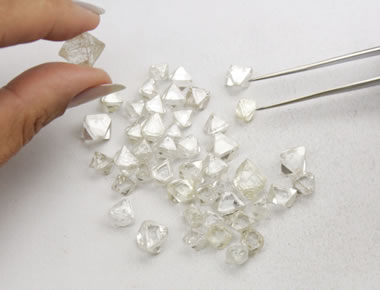
Octahedral diamonds: A high proportion of ALROSA's diamond production is in the form of regularly shaped octahedral crystals. This allows them to be cut into gems with a minimum of processing time and expense. Image provided by ALROSA.
Russia
Diamonds have been found in Russia as far back as the 18th century. The first significant production occurred in 1957 from the Mir kimberlite pipe and its adjacent placers. Since then, numerous diamondiferous pipes and alluvial deposits have been found. Most of Russia's diamond production to date has been from open-pit mines at the Mir and Udachnaya pipes in the Siberian Republic of Sakha.
Today, Russia is the world's leading producer of gem-quality diamonds on the basis of carat weight and has held that position for over a decade. Botswana is the only country that has a higher production value - mainly because its production includes a high proportion of large, high-quality diamonds.
ALROSA, a Russian group of diamond mining companies, produces almost all of the diamonds mined in the country. ALROSA grades and sells its rough diamonds to a number of polished diamond manufacturers, mostly located in Russia, Belgium, India, Israel, Hong Kong and China. Most sales are through long-term supply agreements, but the company also engages in one-time sales and is developing methods for selling online.
Primary control of ALROSA is in the hands of Russian government agencies. The Russian Federation Agency for Management of State Property owns approximately 44%; the Republic of Sakha's Ministry of Property and Land Relations owns approximately 25%; and municipal district administrations of the Republic of Sakha own approximately 8%. The remaining approximately 23% is owned by individuals and legal entities.
Botswana
Botswana was one of the first areas where bulk sampling and indicator mineral mapping were used to characterize and identify diamond pipes across a large and difficult geographic area. Exploration began in the 1950s and diamond mining began in 1971. By the mid-1980s Botswana had some of the highest yielding mines in the world, and the tiny country was among the world's leading diamond producers.
For over a decade, Botswana has been the second-leading producer of diamonds on the basis of carat weight and the leading producer on the basis of value. It holds this position because its average diamond size is larger than what is produced by Russia and of a general higher quality.
Botswana's Jwaneng mine is often referred to as "the richest diamond mine in the world." The mine has been producing about 10 million carats of high-quality diamonds per year. The mine is owned by a company named Debswana, a joint venture company between De Beers and the government of Botswana - hence the name "Debswana."
The diamond industry is the most important contributor to economic activity in Botswana. Diamonds account for about 60% of Botswana's exports and about 25% of its gross domestic product. De Beers is in charge of selling all of Debswana's rough and has built the largest diamond sorting and selling facility in the world in Gaborone, the capital and largest city of Botswana. There, stones mined by De Beers in Botswana, Canada, Namibia and South Africa are sorted and offered to diamond buyers and manufacturers from around the world in De Beers' famous "sightholder sales."
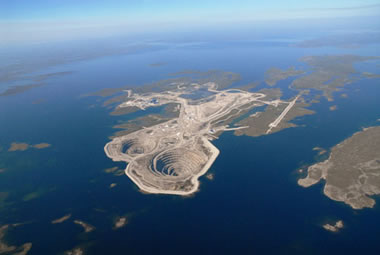
Diavik Diamond Mine: Aerial photograph of the Diavik Diamond Mine located in the North Slave Region of Canada's Northwest Territories. Diavik was the second diamond mine to open in Canada, producing its first diamonds in 2003. The pipes being mined were originally exposed on the bottom of Lac de Gras. Dikes were built around the pipes, and the area to be mined was dewatered by pumping. This created an island which now allows mining below the level of the surrounding lake. Photo courtesy of The Diavik Diamond Mine.

Canadian certified diamond: Artistic photo of a diamond ring atop of a CanadaMarkTM certificate of origin. For this diamond the certificate indicates the mine of origin, the rough weight, the polished weight and the serial number of the diamond. The serial number is inscribed on the girdle of the diamond along with the CanadaMarkTM hallmark. This is an assurance of the integrity of the supply chain of Canadian certified diamonds from mine to retail. Image Copyright 2016 Dominion Diamond Corporation.
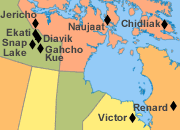
Related: Diamond Mines in Canada
Canada
Canada has been the big surprise in the diamond industry. Geologists suspected that gem-bearing diamond pipes pierced the rocks of the Canadian Shield, but many of the world's most experienced diamond explorers failed to find them. Then in 1991, two geologists, Chuck Fipke and Stewart Blusson, found evidence of diamond-bearing kimberlite pipes about 200 miles north of Yellowknife, Northwest Territories. The deposit proved to be commercial, and mining there began in 1998. A few other mines came online in rapid succession, quickly making Canada one of the world's leading diamond producers.
Some of Canada's mines have already been closed as a result of difficult mining conditions or ore bodies being worked out. However, the country's position as the third-leading producer of diamonds in the world has been maintained. Most of Canada's mines are in remote and frigid locations in the northern part of the country. Some can only receive their heavy supplies by trucks that travel on ice roads that can only be crossed during the coldest months of the year. The mines must also have all of the facilities needed to house and support their employees for months at a time. The mines have succeeded even when faced with these costly challenges.
Canadian diamonds have been popular with consumers. Some like them because they are being produced away from conflict, where workers are paid well, and where regulations are in place to protect the environment. Diamond and jewelry manufacturers in Canada have promoted their national origin by inscribing their girdles with certificate numbers and trade logos. These include a maple leaf, polar bear, CanadaMark symbols or the words "Ice on Fire." These inscriptions assure consumers of their diamond's origin, connects it to a certificate, and has been a very successful marketing feature.
Angola
Diamond mining began in Angola over 100 years ago while it was a Portuguese colony. The earliest production was from the country's many alluvial deposits, and those diamonds were exported to Europe by Portuguese merchants. Today, Angola has been one of the world's leading diamond producers on the basis of dollar value and volume for over a decade. Alluvial diamond mining remains important, and the discovery and development of several diamond pipes will make hard rock mining an important contributor to Angola's production.
One mine of particular note is the Lulo Mine, owned by Lucapa Diamond Company. It is an alluvial mine that produces some of the world's largest type IIa diamonds. Type IIa diamonds are often colorless because they contain very little nitrogen substituting for carbon in the crystal lattice. Some type IIa diamonds from Lulo have an attractive pink color - one of the most popular diamond colors. Large colorless diamonds and attractive pink diamonds give the Lulo production a high value.
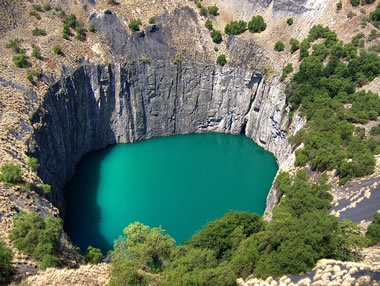
The Big Hole diamond mine: This is a photo of "The Big Hole" diamond mine in Kimberley, South Africa. The mine was started in 1871 and closed in 1914. Thousands of workers toiled to excavate the 42-acre open pit portion of this mine by hand to a depth of nearly 800 feet. It is considered to be the largest hand-dug excavation in the world. It produced about 3000 kilograms (14,000,000 carats) of gem-quality diamonds. Photo by Wikipedian Irene2005, used here under a Creative Commons license Attribution 2.0 Generic.

South Africa
South Africa can be considered the birthplace of the modern diamond industry. That occurred in the 1870s when mining began in several diamond pipes near the town of Kimberley. Before then, almost all diamonds were mined from unconsolidated sediments, mostly by artisanal methods. South Africa immediately became the leading producer of gem-quality diamonds and held that position until the 1920s, when production growth in the Democratic Republic of Congo earned that country the title of top diamond-producing nation.
South Africa has remained a consistent producer and now mines a few million carats of gem-quality diamonds per year. Some of this production comes from diamond pipes that were first mined in the 1800s. They began as hand workings in the soil and weathered rock above a diamond pipe, progressed as open-pit mines that excavated deep into the kimberlite, and then went underground when open-pit mining became too costly.
South Africa continues producing diamonds from alluvial deposits and pipes within the country. Diamond mining also takes place along the coastline of the country. For millions of years, erosion removed diamonds from inland locations, and rivers have brought them to the coast and dropped them along with the shoreline sediments. These diamonds are now being mined off the coast of South Africa and even off the coast of Namibia where they have been carried by strong longshore currents and wave action.
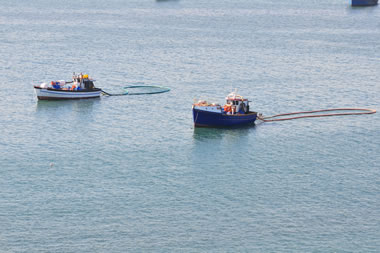
Seafloor mining off the coast of Namibia: Some of the seafloor mining for diamonds off the coast of Namibia is done using small boats such as the ones shown in the photo. Each of these boats is equipped with a pump that pulls water up to the surface through a hose that is used by a diver on the seafloor to vacuum up loose sediment. At the surface, the sediment from the ocean floor is processed through equipment that captures high-density sediment grains and discharges all other grains back into the ocean. Diamonds have a specific gravity of 3.4 to 3.6 compared to the typical sediment grain that has a specific gravity between 2.4 and 2.6. Image copyright iStockphoto / GroblerduPreez.

Diamond mining ship off the coast of Namibia: Namdeb Diamond Corporation uses several large ships to mine diamonds off the coast of Namibia. These ships have equipment that crawls the ocean floor scooping up sediment and delivering it to a processing plant onboard the ship. The processing plant is capable of detecting diamonds in the sediment stream, capturing them, and discharging the processed sediment back into the ocean. These ships can process thousands of tons of sediment per day. The ships are a major investment by Namdeb; they cost about $100 million each. Image copyright iStockphoto / GroblerduPreez.
Namibia
Diamond mining started in Namibia in 1908 after a railroad worker found a small diamond in the desert sand. That discovery triggered a diamond rush and extensive alluvial diamond mining activity. The diamonds were distributed through vast amounts of unconsolidated sediment. Innovative miners developed screening and jigging equipment that enabled them to rapidly separate diamonds from enormous amounts of alluvial sediment.
After World War I, a new type of diamond deposit was found - the raised beach deposits along the Atlantic coast. These deposits could also be efficiently mined using the screening and jigging equipment developed for the alluvial deposits. They have been mined continuously since their discovery, and most Namibian diamonds to-date have been produced from these deposits. As these deposits were mined to the coastline, the miners developed methods to mine them from the ocean floor.
Today diamonds are being mined off shore in Namibia's exclusive economic zone in water over 140 meters deep. This activity has made Namibia the world's leading undersea miner. The diamonds produced from these deposits are of exceptional quality. They have been weathered from their source rock in the interior of the African continent, washed down rivers, deposited in the Atlantic Ocean and then transported by waves and longshore currents along the African coast. They survive all of this travel in excellent condition because of their hardness and durability. Fractured and heavily included diamonds are more vulnerable to the long-distance transport. As a result, a high percentage of the diamonds produced along the Namibian coast are of gem quality with a very high average value per carat.
Most of the diamond mining activity in Namibia is currently done by Namdeb Diamond Corporation, a partnership owned in equal shares by the Government of the Republic of Namibia and The De Beers Group of Companies.
Australia
Australia entered commercial production in 1981 and quickly became the top producer of gem-quality diamonds. In recent years, production in Australia has fallen sharply as deposits there have been depleted with insufficient discoveries to replace them. In 2013, Rio Tinto opened the new Argyle underground diamond mine in Western Australia. The open-pit mine at Argyle had been a steady producer of diamonds since 1983 and the world's leading source of natural fancy-colored diamonds. The underground mine extended Argyle's life until 2020.
United States Diamond Production
Although the United States is the largest consumer of gem-quality diamonds, it has no commercial mine production. The only location in the United States that currently produces gem-quality diamonds is the Crater of Diamonds State Park in Arkansas, where tourists can pay a small fee to prospect and keep any diamonds that they find. In an exceptional year, the park will produce a few hundred carats. This lack of domestic production requires the United States to import virtually all of its diamond consumption.
The Next Big Diamond Discovery?
Where will the next big diamond discovery occur? Perhaps it will be in Canada where another group of difficult-to-find kimberlite pipes are located, or perhaps it will be in the outback of Australia or poorly explored areas of Siberia? Or, could it be in the United States where rocks similar to the Canadian production areas are starting to attract attention?
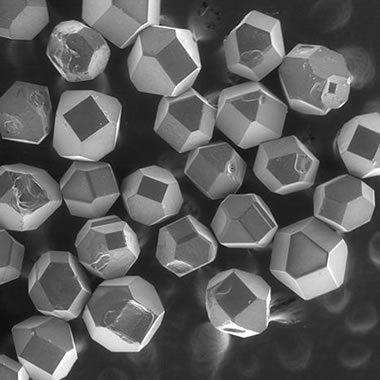
Synthetic diamonds grown in the High-Temperature Materials Laboratory of the Moscow Steel and Alloys Institute. Photo by Wikipedian Lidvig14, used here under a Creative Commons Attribution-ShareAlike 3.0 Unported license.
| Diamond Information |
|
[1] Mineral Commodity Summaries 2024: U.S. Geological Survey, January 2024.
[2] Gemstones: Donald W. Olson, U.S. Geological Survey, 2016 Minerals Yearbook, January 2020. |
Synthetic Diamond Production
For many years we published this page when it was very legitimate to use the terms "diamond production" and "diamond mining" as equivalent - at least for gem-quality diamonds.
That has changed.
The United States Geological Survey reports that in 2015, an estimated $52.4 million dollars' worth of gem-quality diamonds were produced in laboratories within the United States. An unknown amount is also being produced in laboratories outside of the United States. Most of these synthetic diamonds are entering the gemstone market and disclosed as "lab-created" or "lab grown" or "synthetic" at the time of sale to consumers. When this occurs these man-made diamonds generally sell at a price that is at least 25% lower than the cost of natural diamonds for stones of similar size and quality.
The man-made diamonds are extremely difficult and costly to distinguish from natural diamonds, especially at the wholesale level when synthetic diamonds are inserted into large lots of very small diamonds. This infiltration of synthetic stones into the stock of natural stones has brought concerns to the gem and jewelry trade and also to consumers. Is my diamond "natural"?
Most consumers are still buying "natural diamonds" because the supply of lab-created diamonds is relatively small. However, a lower selling price attracts certain consumers to lab-created diamonds because they have the same chemical composition, the same physical properties, and to the eye they look exactly like natural diamonds.
Time will tell how dedicated consumers will be to natural diamonds and how much of a discount they are willing to resist.
| More Diamonds |
 |
Colored Diamonds |
 |
Diamond |
 |
Blood Diamonds |
 |
World*s Largest Diamonds |
 |
Canadian Diamond Mines |
 |
Diamonds Do Not Form From Coal |
 |
Carbonado |
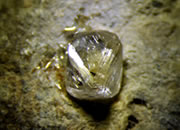 |
Kimberlite |

Find Other Topics on Geology.com:
|
| ||

|
| ||
|
| ||

|
|