
Biotite
Biotite is a group of black mica minerals found in igneous and metamorphic rocks.
Article by: Hobart M. King, PhD
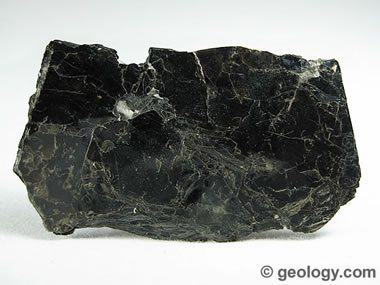
Biotite: Biotite from Bancroft, Ontario, Canada. Specimen is approximately 4 inches (10 centimeters) across.
What is Biotite?
Biotite is a name used for a large group of black mica minerals that are commonly found in igneous and metamorphic rocks. These include annite, phlogopite, siderophyllite, fluorophlogopite, fluorannite, eastonite, and many others. These micas vary in chemical composition but are all sheet silicate minerals with very similar physical properties.
A generalized chemical composition for the biotite group is:
The name "biotite" is used in the field and in entry-level geology courses because these minerals generally cannot be distinguished without optical, chemical, or x-ray analysis.
Biotite is a rock-forming mineral found in a wide range of crystalline igneous rocks such as granite, diorite, gabbro, peridotite, and pegmatite. It also forms under metamorphic conditions when argillaceous rocks are exposed to heat and pressure to form schist and gneiss. Although biotite is not very resistant to weathering and transforms into clay minerals, it is sometimes found in sediments and sandstones.
Physical Properties of Biotite |
|
| Chemical Classification | Dark mica |
| Color | Black, dark green, dark brown |
| Streak | White to gray, flakes often produced |
| Luster | Vitreous |
| Diaphaneity | Thin sheets are transparent to translucent, books are opaque. |
| Cleavage | Basal, perfect |
| Mohs Hardness | 2.5 to 3 |
| Specific Gravity | 2.7 to 3.4 |
| Diagnostic Properties | Dark color, perfect cleavage |
| Chemical Composition | K(Mg,Fe)3(AlSi3O10)(F,OH)2 |
| Crystal System | Monoclinic |
| Uses | Very little industrial use |
Properties of Biotite
Biotite is very easy to identify, and with a little experience a person will be able to recognize it on sight. It is a black mica with perfect cleavage and a vitreous luster on the cleavage faces.
When biotite is separated into thin sheets, the sheets are flexible but will break upon severe bending. When held up to the light, the sheets are transparent to translucent with a brown, gray, or greenish color. Experienced observers can sometimes recognize phlogopite by its brown color.
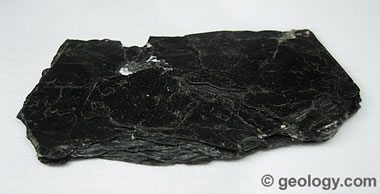
Biotite angled view: Biotite from Bancroft, Ontario, Canada. Specimen is approximately 4 inches (10 centimeters) across.
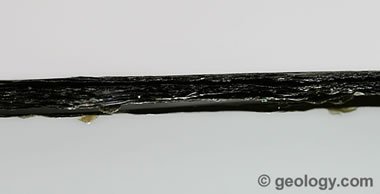
Biotite side view: An edge view of the biotite specimen from the photo above. Specimen is approximately 3/8 inch (.95 centimeter) thick.
Biotite Minerals
As noted above, biotite is a name used for a number of black mica minerals that have different chemical compositions but very similar physical properties. These minerals generally cannot be distinguished from one another without laboratory analysis. A small list of the biotite minerals is given below with their chemical compositions.
| Mineral | Chemical Composition |
| Annite | KFe3(AlSi3)O10(OH)2 |
| Phlogopite | KMg3(AlSi3)O10(F,OH)2 |
| Siderophyllite | KFe2Al(Al2Si2)O10(F,OH)2 |
| Eastonite | KMg2Al(Al2Si3)O10(OH)2 |
| Fluorannite | KFe3(AlSi3)O10F2 |
| Fluorophlogopite | KMg3(AlSi3)O10F2 |
Uses of Biotite
Biotite has a small number of commercial uses. Ground mica is used as a filler and extender in paints, as an additive to drilling muds, as an inert filler and mold-release agent in rubber products, and as a non-stick surface coating on asphalt shingles and rolled roofing. It is also used in the potassium-argon and argon-argon methods of dating igneous rocks.
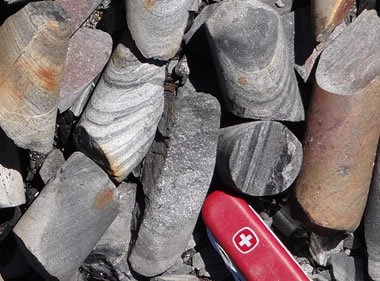
Biotite in sandstone: Core samples of biotitic sandstone from the Apple Creek Formation, Copper Queen Mine, near Salmon, Idaho. USGS image.

The best way to learn about minerals is to study with a collection of small specimens that you can handle, examine, and observe their properties. Inexpensive mineral collections are available in the Geology.com Store. Image copyright iStockphoto / Anna Usova.
The Other "Fool's Gold"
Biotite and the brown mica known as phlogopite have been known to cause excitement in inexperienced gold panners. A few tiny flakes of these micas swishing in a gold pan can produce bright bronze-colored reflections in the pan when struck by sunlight. These reflections can fool the inexperienced panner into thinking that he has found gold. If the panner regains his composure, removes one of these flakes from the pan and pokes it with a pin, it will break. First-time panners quickly learn to do some testing before shouting "gold" - which probably isn't a good idea even when gold is found because it can attract unwanted visitors to your panning spot.
Small flakes of biotite have also been known to cause excitement when they are observed in rocks. Their bronze-colored reflections can fool the inexperienced observer into thinking that tiny flakes of gold are present. Again, the pin test or a hand lens will usually yield a quick answer as to whether it is real gold or fool's gold.
| More Minerals |
 |
Herkimer Diamonds |
 |
The Acid Test |
 |
Tumbled Stones |
 |
Zircon |
 |
Fool*s Gold |
 |
Kyanite |
 |
Rock Tumblers |
 |
Rhodochrosite |

Find Other Topics on Geology.com:
|
| ||

|
| ||

|
| ||

|
|